How to remove weeds in summer corn fields? A detailed guide to practical control methods
How to remove weeds in summer corn fields? Please explain the methods. Summer corn and weeds both grow quickly and in concentrated flushes. Corn seedlings suffer the most severe weed damage during the seedling stage; in the mid-to-late stage, corn can form a tall, dense canopy, and weed emergence and growth are suppressed, with little impact on yield. Weed control in corn fields should focus on the two key periods after sowing before seedling emergence and early post-emergence. The integrated weed control plans for the different periods are as follows:
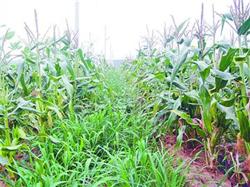
How to remove weeds in summer corn fields? Please explain the methods.
Summer corn and weeds both grow quickly and in concentrated flushes. Corn seedlings suffer the most severe weed damage during the seedling stage; in the mid-to-late stage, corn can form a tall, dense canopy, and weed emergence and growth are suppressed, with little impact on yield. Weed control in corn fields should focus on the two key periods after sowing before seedling emergence and early post-emergence. The integrated weed control plans for the different periods are as follows:
I. Weed control after corn sowing before seedling emergence
1. For fields with no weeds, closed soil treatment can be used. Commonly used herbicides: 42% propisochlor·atrazine, acetochlor·atrazine, butachlor·atrazine, etc. at 250-300 g/mu. Yulong, Yushuangchan, Zechu, 66% Chuda, etc. can also be chosen.
2. For fields with many weeds after wheat harvest, implement "one closed treatment plus one kill": propisochlor·atrazine 250-300 g plus 4% nicosulfuron 80-100 g or 20% paraquat 150-200 g/mu; in addition, Fengchi, Fengji, Shuangxiao Fengji, etc. can be chosen for closed treatment plus kill.
Tips: 1. Choose herbicide varieties with sufficient active ingredient content and formal national registration. 2. Master the four points of "early, moist, amount, good." "Early" means applying the herbicide early; soil treatment agents should be applied as much as possible before weeds emerge. "Moist" means ensuring soil moisture before and after application. "Amount" means using an appropriate dose; for fields with high wheat stubble, much wheat straw and wheat ash, and high organic matter content, increase the dose by 30%-50%, and increase the water volume when spraying. "Good" means good spraying technique: prepare the land finely, use sufficient water volume, spray evenly, and do not spray twice in the same spot or miss spots.
II. Early post-emergence weed control in corn
1. From the 1-3 leaf stage of corn before weeds emerge to the 1-2 leaf stage of weeds, commonly used herbicides: 42% propisochlor·atrazine, acetochlor·atrazine, butachlor·atrazine, etc. at 250-300 g/mu. In addition, Yulong, Yushuangchan, Zechu, 66% Chuda at 180-250 g/mu, etc. are also available.
2. If weeds are not controlled in time at the 3-5 leaf stage of corn, growth and yield will be directly affected. When corn is at the 3-5 leaf stage and weeds are at the 2-5 leaf stage, the following herbicides can be chosen: 4% nicosulfuron suspension concentrate 80-110 mL/mu; Fengji (4% nicosulfuron plus oxaziclomefone·isoproturon·atrazine) 100-120 g; 42% Shuangxiao Fengji suspension concentrate 180-250 mL/mu; 56% Fengji Fuziqing (MCPA plus nicosulfuron plus atrazine) 100 g/mu.
3. Control at the 3-5 leaf stage of corn when troublesome weeds occur heavily: 1. For fields with many purple nutsedge plants. Commonly used herbicides: 56% Fengji Fuziqing (MCPA plus nicosulfuron plus atrazine) 100 g/mu; Fengji (4% nicosulfuron plus oxaziclomefone·isoproturon·atrazine) 100-120 g; 48% bentazone 150-200 mL/mu; 2. For fields with many purple nutsedge, field bindweed, purslane, small thistle, lambsquarters, etc. Commonly used herbicides: 4% nicosulfuron or nicosulfuron-atrazine formula 90-120 mL/mu plus 56% Shakualing 60 g.
4. For fields with many weeds at the 5-8 leaf stage of corn, the above herbicides can be chosen and applied as a directed spray along the rows while avoiding the corn whorl.
5. For corn varieties with poorer herbicide tolerance, such as sweet corn, waxy corn, and popcorn: before emergence, 42% Yulong, Yushuangchan, Zechu, etc. can be chosen; after corn emergence and weed emergence, imported 55% Gengjie, or domestic 40% Suxiao Fengji (sulfentrazone plus atrazine) 180-300 mL/mu can be chosen promptly.
Tips: 1. The application of post-emergence corn herbicides requires mastering the timing. If weeds are too large, their tolerance increases; if weeds are too small, they do not have enough leaf area to absorb the herbicide, and the purpose of weed control cannot be achieved. 2. The temperature should not be too high. In hot, dry weather, systemic post-emergence herbicides evaporate soon after spraying, and absorption and translocation are slow, which is not conducive to herbicide efficacy. 3. Do not spray organophosphorus pesticides within 7 days before or after chemical weed control, and do not use motorized sprayers. Under high temperature conditions, it is best to avoid the corn whorl to prevent herbicide damage.
III. Directed inter-row weed control before corn canopy closure
For fields where chemical weed control in the early growth stage of corn was not ideal, after the 8-leaf stage of corn, when plant height exceeds 60 cm and the stem base has aged and turned purple, use 20% Fengchi paraquat 150-200 g/mu, or 25% oxadiazon Fengchi paraquat 100-150 g/mu, and apply as a directed spray with water.
Tips: When applying, add a spray shield and do not spray onto the crop. Use clean fresh water to mix the herbicide; do not use river water, well water, or other water with many impurities. Applying at noon with sufficient light and high temperature gives good results.
Click to get more corn planting techniques
Click to get more food crop planting techniques