How should autumn radishes be planted to improve their quality?
How can the quality of autumn radishes be improved? Please advise. To improve the quality of autumn radishes, you can refer to the following methods: 1. Choose excellent varieties. For example, varieties whose fleshy roots penetrate relatively shallowly into the soil are less prone to deformed roots; varieties whose fleshy roots contain less water and varieties with dense flesh are less prone to splitting; faster-growing white-skinned...
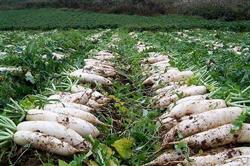
How can the quality of autumn radishes be improved? Please advise.
To improve the quality of autumn radishes, you can refer to the following methods:
1. Choose excellent varieties. For example, varieties whose fleshy roots penetrate relatively shallowly into the soil are less prone to deformed roots; varieties whose fleshy roots contain less water and varieties with dense flesh are less prone to splitting; faster-growing white-skinned varieties or first-generation hybrids have less pungency and bitterness than green-skinned varieties, making them suitable for summer and autumn cultivation. At the same time, choose seeds of pure variety that are large and plump, with purity and cleanliness reaching above 95%.
2. Choose a suitable cultivation season. For example, radish varieties grown for raw consumption should be sown appropriately late in autumn, as their mustard oil content is low and their quality is good.
3. Choose soil with a deep plow layer. The soil should be finely tilled, plowed deep 18-20 cm, and harrowed fine after plowing; deep plowing of the soil is one of the key measures for a high radish yield. Apply 2000-3000 kg of fully decomposed high-quality farmyard manure and 30 kg of NPK compound fertilizer per 667 sq m.
4. Water reasonably and avoid alternating drought and moisture. Radishes have different water requirements at different growth stages. During the germination stage, sufficient water should be supplied to promote rapid germination and uniform emergence. During the seedling stage, follow the principle of "water little but often"; during the period before the seedling root-splitting stage, water less and encourage seedling establishment to inhibit lateral root growth and encourage the taproot to grow deep into the soil. During the fleshy root swelling stage, increase irrigation to maintain balanced and sufficient soil moisture.
5. Pest and disease control. The main pests of radishes include: aphids, cabbage caterpillars, striped flea beetles, etc., and the diseases include black rot, viral disease, soft rot, black spot, etc., which can be controlled with commonly used pesticides.
Click to get more radish cultivation techniques
Click to get more vegetable cultivation techniques