How should radishes be grown to meet pollution-free standards?
How do you grow pollution-free radishes? Here is a detailed introduction to the growing method. To grow pollution-free radishes, you can refer to the following: site selection and sowing. For pollution-free radishes, the key point in site selection is that they must not be near heavily polluted industrial factory areas, and the source of irrigation water must not be polluted either. In addition, radishes have a relatively wide adaptability to soil...
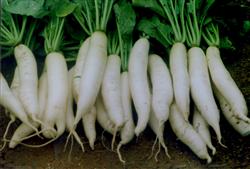
How do you grow pollution-free radishes? Here is a detailed introduction to the growing method
To grow pollution-free radishes, you can refer to the following:
Site selection and sowing
For pollution-free radishes, the key point in site selection is that they must not be near heavily polluted industrial factory areas, and the source of irrigation water must not be polluted either. In addition, radishes have relatively wide adaptability to soil, with the overall requirements being deep soil, good water retention and drainage, and rich organic matter content. However, radishes have high requirements for land preparation. For fields planted with radishes, after the previous crop is harvested, the field should be cleaned early, then plowed and sun-baked, with plowing to a depth of 20-25 cm. After fertilizing and harrowing, make small raised beds or small raised ridges to prevent waterlogging and flooding. After fertilizer application, remove large bricks, tiles, glass, grass roots, and waste plastic film and other debris from the field to prevent radishes from forking or splitting during growth.
Use 250-300 grams of radish seed per mu of field. First mix with 10-15 kg of fine soil, then sow evenly (for ridge cultivation, hole sowing or furrow drilling can be used). After sowing, cover with soil 1-1.5 cm thick. If conditions permit, cover with shade netting to lower the temperature and protect against heavy rain, avoiding soil crusting caused by heavy rain that affects emergence. For Manshenhong radishes, the row spacing is generally about 30 cm, and the hole spacing is 20-25 cm; for Chunbulao radishes, the row spacing is 33 cm, and the hole spacing is 27 cm. If the weather is dry after sowing, water frequently in small amounts to keep the ground moist and lower the soil temperature, so as to favor emergence. If heavy rain occurs, drain promptly to prevent waterlogging. If the beds or ridges are washed away, replant promptly after the rain.
Fertilization techniques
Base fertilizer. Radishes are generally grown by direct sowing, so base fertilizer is the main factor in high-yield radish production. As base fertilizer, 2500-3000 kg of decomposed (pay special attention to this) barnyard manure, 10 kg of potassium sulfate, and 25-30 kg of superphosphate can be broadcast per mu and plowed into the soil. In some places, farmyard manure can be used as base fertilizer along with a certain amount of cake fertilizer, which can make the fleshy roots very plump and less likely to become hollow during storage, which is beneficial for pollution-free radish production.
Topdressing: the first time is when the seedlings grow to the true-leaf stage, apply 1000 kg of decomposed dilute human waste. After thinning to a stand, apply another round of decomposed dilute human waste. When the fleshy root "breaks belly" (the beginning of fleshy root expansion and accelerated growth), apply a third topdressing of 800-1500 kg of decomposed human waste at 50% concentration plus 5 kg of superphosphate and 5 kg of potassium sulfate. Manshenhong radishes generally receive only these three applications. Chunbulao radishes can receive 1-2 more topdressings during the vigorous growth period of the fleshy root. If the aboveground leaves are especially dark green and large and growth is excessive, then no more fertilizer should be applied, and 20 grams of 15% paclobutrazol mixed with 50 kg of water should be sprayed to inhibit aboveground growth and promote expansion of the underground fleshy root. If too much nitrogen fertilizer is applied, while the air and soil are dry and the roots are damaged, the plant's calcium uptake is hindered, causing leaf margin rot, and symptoms such as deep pores and many long lateral roots on the root surface. Therefore, in the later stage of radish growth, the amount of nitrogen fertilizer should be controlled, and attention should also be paid to the supply of soil boron to prevent hollow heart and black heart in radishes.
Field management
Thinning and stand establishment: thin the radishes once each at full emergence and at the 2-3 true-leaf stage. At the 4-5 true-leaf stage, establish the stand, leaving one plant per hole.
Fertilizer and water management: radishes are afraid of both drought and excessive moisture. When there is a lot of rain, drain promptly to reduce waterlogging. Radish leaves have a relatively large area and strong transpiration, and their drought resistance is relatively poor, so sufficient water must be supplied in a timely and appropriate amount. Before sowing, water thoroughly to ensure rapid and uniform emergence; at the seedling stage and rosette stage, water less to promote deep penetration of the taproot into the soil and prevent excessive leaf growth, following the principle of "do not water unless the soil is dry, and water only when the surface turns white"; during the vigorous root growth period, supply water fully and evenly to promote fleshy root expansion, prevent hollowing, improve quality, and enhance storage tolerance. For autumn cultivation, watering in the evening is best, which helps lower soil temperature and promote the transport and storage of nutrients to the roots.
The fertilization principle for radishes is "base fertilizer as the main part, topdressing as the supplement." Varieties with sufficient base fertilizer and a short growth period can receive less topdressing, while varieties with a long growth period should be topdressed in stages, with emphasis on topdressing during the early growth stage of radishes and the vigorous growth period of the fleshy root.
Pest and disease control: the main pests and diseases of radishes include aphids, cabbage beetles, cabbage caterpillars, striped flea beetles, beet armyworm, as well as viral disease, black rot, and others. To make radishes meet pollution-free standards, the following points should be carried out specifically. First, rational crop rotation, rational close planting, and field sanitation to improve the field microclimate environment and reduce the occurrence and damage of diseases; second, use shade netting and insect-proof netting coverage technology, which can reduce the occurrence of pests such as cabbage caterpillars and beet armyworm; third, choose biological pesticides and high-efficiency, low-toxicity pesticides, and adhere to applying them at the appropriate time and in the appropriate amount. Fourth, strictly observe the pesticide interval period, and stop applying pesticides 2 weeks before harvest.
Harvest at the appropriate time: when the fleshy root of the radish has fully expanded and the leaf color fades and begins to turn yellow-green, harvest promptly for market. Harvest as early as appropriate, which on the one hand can improve economic returns, and on the other hand can avoid pithiness caused by factors such as overgrowth or drought.
"Three Products" application: if the radishes grown meet the requirements of the "Three Products" (pollution-free agricultural products, green food, organic food) in terms of the growing environment and the product itself, and the grower is willing to raise the grade of their radishes, they can apply to the relevant government departments for the "Three Products."
Click to get more radish growing techniques
Click to get more vegetable growing techniques