Fertilization Methods and Techniques for Sesame in the Middle and Late Stages of Summer Planting
How should fertilization be done in the middle and late stages of summer-planted sesame? Please give an introduction. For summer-planted sesame, fertilization should involve heavy and shallow application of base fertilizer, moderate application of seed fertilizer, heavy application of flower bud fertilizer, and supplementary spraying of phosphorus and potassium fertilizers; organic fertilizer should be the main type, combined with phosphorus and potassium fertilizers, and the amount of chemical fertilizer should be reduced as much as possible to improve sesame quality. For every...
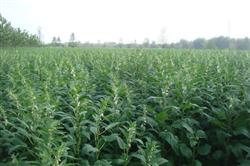
How should fertilization be done in the middle and late stages of summer-planted sesame? Please give an introduction.
For summer-planted sesame, fertilization should involve heavy and shallow application of base fertilizer, moderate application of seed fertilizer, heavy application of flower bud fertilizer, and supplementary spraying of phosphorus and potassium fertilizers; organic fertilizer should be the main type, combined with phosphorus and potassium fertilizers, and the amount of chemical fertilizer should be reduced as much as possible to improve sesame quality. For every 100 kg of sesame produced, the fertilizer requirement is: nitrogen fertilizer 6.24-8.13 kg, phosphorus fertilizer 2.19-3.28 kg, potassium fertilizer 6.24-10.19 kg.
However, in summer sesame cultivation, most farmers do not apply base fertilizer, and for topdressing they only apply urea or a small amount of compound fertilizer. Unreasonable fertilizer application seriously affects the exertion of sesame's yield-increasing potential.
At present, summer sesame in various places has entered the middle growth stage, and fertilizer management in the middle and late stages must be carried out promptly to achieve increased yield and income.
Supplementary base fertilizer: For fields where no base fertilizer has been applied, topdressing should be carried out promptly to prevent fertilizer deficiency. For high-yield fields, apply 10 kg of high-quality potassium sulfate compound fertilizer per mu, shallowly buried 4-6 cm deep; for medium- and low-yield fields, apply 10 kg of high-quality potassium sulfate compound fertilizer per mu plus 5 kg of urea.& amp; amp; amp; amp; amp; amp; amp; amp; amp; amp; amp; amp; amp; amp; amp; amp; amp; amp; amp; #160;
Heavy application of flower bud fertilizer: For fields where base fertilizer has already been applied, flower bud fertilizer should be applied heavily. For single-stem sesame, apply flower bud fertilizer from budding to early flowering; for thin soil fertility or poor growth, it should be applied appropriately earlier; for branching sesame, topdressing when branches appear is preferable. Generally, apply 5-10 kg of urea per mu plus 5 kg of high-quality potassium sulfate compound fertilizer, or apply 10-15 kg of high-quality potassium sulfate compound fertilizer per mu.
Supplementary spraying of phosphorus and potassium fertilizers: At the early flowering stage of summer sesame, use 50 kg of 0.3%-0.4% potassium dihydrogen phosphate solution per mu, spray evenly once every 5-6 days, for 2-3 consecutive sprays. At the same time, 50 kg of borax, ammonium molybdate solution, or zinc sulfate solution can also be sprayed at intervals per mu, which can increase yield by more than 10% per mu. Generally, the spraying concentration is 0.2% for borax, 0.05% for ammonium molybdate, and 0.2% for zinc sulfate.
Click to get more sesame cultivation techniques
Click to get more food crop cultivation techniques