Key Technical Points for Sesame Planting and Management in Summer
How to manage sesame planted in summer properly? Please introduce the methods. Sesame planted in summer can be managed by referring to the following methods: 1. Thinning and final singling of seedlings. 3-5 days after sesame emerges, when the first pair of opposite true leaves appears (farmers call it the "cross"), carry out the first thinning. When the second and third pairs of true leaves appear...
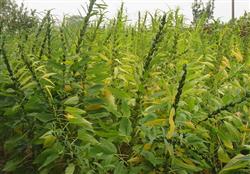
How to manage sesame planted in summer properly? Please introduce the methods
Sesame planted in summer can be managed by referring to the following methods:
1. Thinning and final singling of seedlings
3-5 days after sesame emerges, when the first pair of opposite true leaves appears (farmers call it the "cross"), carry out the first thinning. When the second and third pairs of true leaves appear, carry out the second thinning; at this time, remove weak seedlings and keep strong ones, and carry out preliminary final singling. To prevent pests, diseases and mechanical damage during thinning and final singling, it is advisable to thin and single the seedlings in 3 rounds, that is, first thinning, second thinning, and third final singling. The method is: where sparse, keep dense; where dense, keep sparse; where neither sparse nor dense, keep strong seedlings. Make sure the spacing is even, keep a good stand, and do not leave double seedlings.
2. Intertillage and earthing up
As the farming proverb says: "The sesame flower head needs three graspings." When the first and second pairs of true leaves appear, carry out the first intertillage, but hoeing the surface soil is appropriate as the first grasping; when the third pair of true leaves appears, carry out the second intertillage, and this time deep tillage of 3-6 cm can be done as the second grasping; when the fourth to fifth pairs of true leaves appear, carry out the third intertillage and earthing up, and at this time the intertillage depth can reach about 8 cm as the third grasping. The second and third intertillage and earthing up can play a role in weed control and covering the roots, which is beneficial to root growth, prevents waterlogging damage, reduces the occurrence of diseases, and also helps suppress weed growth and prevent lodging.
3. Scientific water use
Sesame is extremely sensitive in its response to water demand; it cannot endure long-term drought, nor can it tolerate waterlogging. The water requirement of sesame at the seedling stage is relatively small. If soil moisture is good at sowing, it can already meet the plant's water requirements, so watering may not be needed. However, entering the flowering and capsule-setting stage, it is very sensitive to water requirements; at this time it fears both waterlogging and drought, so be sure to water in time when drought occurs and drain in time when waterlogging occurs. By the topping stage, water demand gradually decreases. If humidity is maintained well during the flowering and capsule-setting stage, then generally no irrigation is needed at this time.
4. Foliar topdressing
From the early flowering stage to the full flowering stage, sesame has a relatively large fertilizer requirement. To prevent fertilizer deficiency at this time, applying quick-acting nitrogen fertilizer before the early flowering stage is most appropriate. During the squaring and flowering stage, sesame's demand for phosphorus and potassium increases markedly, but at this time spray topdressing is more appropriate: use 0.25 kg of potassium dihydrogen phosphate mixed with 100 kg of water for spraying, then spray once every 3-5 days, for 3-5 consecutive sprays.
5. Pest and disease control
The main diseases of sesame include stem spot blight, bacterial wilt, fusarium wilt, damping-off, and fungal angular leaf spot. Control methods: ① drain waterlogged fields and prevent waterlogging; ② rational crop rotation and stubble reversal; ③ select disease-resistant varieties; ④ chemical control, such as treating roots by spraying with a 2000-fold solution of 50% thiophanate-methyl or a 1:1:300 Bordeaux mixture. Pests include cutworms, aphids, sesame hawk moths, mirids, and mole crickets. Use 100 mL of 80% dichlorvos emulsion mixed with 75 kg of water per mu for spray control.
6. Timely harvest
15-25 days after the final flowering stage, sesame can mature. Its characteristics are that the stems and leaves and the fruit change from green to yellow, and leaf drop reaches 70%-80%, while a small number of capsules also show dehiscence; at this time it can be harvested. After harvest, carry out sun-drying, threshing, processing, and finally storage.
Click to get more sesame planting techniques
Click to get more food crop planting techniques