Rice pest and disease control: How to control rice locusts?
How to control rice locusts? What harm do rice locusts cause? Please introduce the harm caused by rice locusts: Rice locusts, commonly known as "grasshoppers," are one of the important pests in the middle and late stages of rice. Both adults and nymphs cause damage, mainly to rice, but also to corn, sorghum, beans and other crops. In mild cases they cause notches, and in severe cases they eat the leaves completely bare. During the milk-ripening stage of rice, they often bite through the panicle neck and small branch stalks, causing white heads and resulting in severe yield reduction.
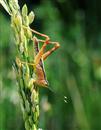 How to control rice locusts? What harm do rice locusts cause? Please introduce
The harm caused by rice locusts:
Rice locusts, commonly known as "grasshoppers," are one of the important pests in the middle and late stages of rice. Both adults and nymphs cause damage, mainly to rice, but also to corn, sorghum, beans and other crops. In mild cases they cause notches, and in severe cases they eat the leaves completely bare. During the milk-ripening stage of rice, they often bite through the panicle neck and small branch stalks, causing white heads and resulting in severe yield reduction.
Rice locust control methods:
1. Spray with 21% miexibei emulsifiable concentrate (synergistic cypermethrin? malathion emulsifiable concentrate) at 1500-2000 times dilution.
2. Spray with 4.5% beta-cypermethrin emulsifiable concentrate at 1500 times dilution.
3. Spray with 21% bisha 2000 emulsifiable concentrate at 1500-2000 times dilution.
4. Use biological pesticides for control. Currently, the biological pesticides used to control locusts include locust microsporidia, Metarhizium anisopliae and azadirachtin. Locust microsporidia are obligate, single-celled protozoans of locusts. After locusts eat food containing microsporidia, they can develop microsporidiosis.
Metarhizium anisopliae is a pathogenic fungus of locusts. After locusts come into contact with this fungus, the fungus can penetrate the locust's skin (body wall) and enter the locust's body to reproduce, or produce toxins, or fill the locust's body with hyphae, causing the locust to die. Azadirachtin is a substance extracted from a tree called neem, and belongs to plant-derived insecticides.
Click to get more rice cultivation techniques
Click to get more grain crop cultivation techniques