How is celery best planted in summer and autumn?
How is celery best planted in summer and autumn? Please provide a method. Summer and autumn celery can be planted by referring to the following three aspects: Sowing and raising seedlings of summer and autumn celery. 1. Sowing time: sow in mid-June, and keep the seedling age at about 40 days. Properly shortening the seedling age can increase the survival rate after transplanting and shorten the recovery period...
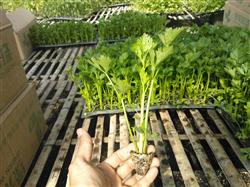 How is celery best planted in summer and autumn? Please provide a method.
Summer and autumn celery can be planted by referring to the following three aspects:
Sowing and raising seedlings of summer and autumn celery
1. Sowing time: sow in mid-June, and keep the seedling age at about 40 days. Properly shortening the seedling age can increase the survival rate after transplanting and shorten the recovery period.
2. Seed soaking and sprouting of celery: Since celery is a cool-loving crop, sowing in the high-temperature season should use low-temperature sprouting. You can soak the seeds in clean water for 12 hours, then add "920" or Aitongshou, etc., and soak for another 12 hours. Clean and drain the swollen seeds, put them in a wet cloth bag and place them in the refrigerator to sprout for 3 to 5 days, with the temperature controlled at about 7°C, turning and washing once a day. When 30% of the seeds have sprouted, they can be sown.
3. Preparation of the celery seedbed: Choose a plot that has not previously grown celery as the seedbed, and apply an appropriate amount of decomposed farmyard manure as base fertilizer 7 days before sowing. Disinfect each square meter of seedbed with 1.5 grams of mancozeb or thiophanate-methyl. Generally, the seedbed area is 80 sq m, and about 150 grams of seed is sown.
4. Building a shade shed and sowing celery: Evenly scatter the sprouted seeds on the seedbed, then cover with 2 cm of rice husk ash or cover with decomposed pig manure until the seeds are no longer visible. After that, build a shade shed, covering it with one layer of film and two layers of shade net, with the shed height at about 1 m. This can prevent damage from heavy rain and also provide shade and cooling. If it is sunny after sowing, water once each morning and evening to cool and keep moisture, which helps emergence.
Transplanting and management of summer and autumn celery
1. Transplanting celery and applying base fertilizer: Begin transplanting when the seedling age is about 38 days, planting the large seedlings first, then the small seedlings. Before transplanting, apply 4000 to 5000 kg of barnyard manure per 667 sq m (1 mu), and also add some phosphorus and potassium fertilizer. If plant ash is spread on the beds before transplanting, it is extremely beneficial for survival and growth. Under normal conditions, celery will mature 3 days earlier and yield will increase by 15%. The amount of plant ash used is 50 kg per 20 sq m. Because celery grows quickly and forms small plants under high-temperature and hot conditions, the density can be slightly greater, generally with a hole spacing of 10 cm and row spacing of 15 cm, planting 6 to 8 plants per hole.
2. Shading and management of celery: Immediately after transplanting, cover with a shade net. To save the amount of net used, it can be laid flat. The height of the shed should be just enough for convenient operation, with each sheet of net spaced 50 cm apart to increase direct sunlight. In continuous sunny and dry weather, water can be poured between the beds to cool them (do not flood the beds), which benefits celery growth. During the covering period, there is no need to remove the net. In the middle stage, quick-acting fertilizer such as urea or human manure and urine can be applied appropriately. In the later stage, apply 15 kg of potassium chloride per 667 sq m, which can greatly increase the weight per plant.
3. Application of micronutrients and growth regulators to celery: Celery is very sensitive to boron, especially under high-temperature and high-humidity conditions. Spraying 2 to 3 times during the growing period with 0.1% boric acid and 0.1% superphosphate extract can prevent leaf stalk cracking and heart rot, prevent yellowing in the later stage, and is also extremely beneficial to plant growth. At the same time, foliar fertilizers such as Yemianbao and Feibao can also be sprayed. Spray gibberellin once 10 to 15 days before harvest at a concentration of 100 mg/kg, which can increase yield and improve quality.
Pest and disease control of summer and autumn celery
The main pests and diseases are early blight, leaf spot, and aphids. In the early stage of disease, spray with 600 times dilution of 75% chlorothalonil, or spray with 1:0.5:200 Bordeaux mixture plus 0.1% sulfur powder, spraying 30 to 40 kg of liquid per 667 sq m, once every 7 days, for 2 to 3 consecutive sprays. For insect pests, spray with 400 to 600 times dilution of 0.4% shaayasu plus 0.1% laundry powder, or spray with 500 to 600 times dilution of 50% dichlorvos for control.
Click to get more celery planting techniques
Click to get more vegetable planting techniques