How can cornfield herbicides be used for the best results?
How can cornfield herbicides be used well? We ask fellow growers to help share their experience. Zhongdiwang has compiled the methods and precautions for using cornfield herbicides, listed below for everyone's reference. Cornfield herbicides, based on application timing and weed-killing principles, are divided into pre-emergence soil-sealing herbicides for corn and post-emergence stem-and-leaf treatment herbicides for corn...
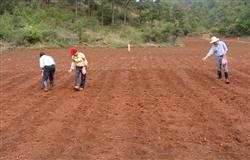 How can cornfield herbicides be used well? We ask fellow growers to help share their experience.
Zhongdiwang has compiled the methods and precautions for using cornfield herbicides, listed below for everyone's reference.
Cornfield herbicides, based on application timing and weed-killing principles, are divided into two major categories: pre-emergence soil-sealing herbicides for corn and post-emergence stem-and-leaf treatment herbicides for corn.
Pre-emergence soil-sealing herbicides for corn:This refers to spraying the herbicide evenly onto the soil surface after corn sowing but before emergence, after corn emergence but before weed emergence, or before weeds reach the 3-leaf stage. Weed seeds distributed in the surface soil layer, under suitable temperature conditions, will rapidly germinate after rainfall or irrigation. Once the elongated weed hypocotyls and young shoots contact the herbicide on the soil surface, they become poisoned, germination of the young shoots stops, or the seedlings wither and die.
Corn seeds are generally distributed below 3 cm of the soil surface. When they germinate and emerge, the hypocotyl remains below the soil and does not contact the herbicide, so it is not poisoned. Common pre-emergence soil-sealing herbicides for corn include atrazine-acetochlor mixture, butachlor-atrazine mixture, isopropyl-atrazine mixture, etc. They have good soil-sealing weed control efficacy against annual broadleaf weeds and grass weeds in cornfields, but are ineffective against perennial weeds.
Post-emergence herbicides for corn:This refers to using the physiological tolerance difference between weeds and corn toward the herbicide, spraying the herbicide onto the stems and leaves of weeds to poison and kill them. Corn contains enzyme substances that can decompose this herbicide, giving it good tolerance. Using this physiological selectivity difference achieves the goal of killing weeds and strengthening seedlings.
Currently the most widely used post-emergence herbicides for corn include nicosulfuron, sulcotrione, 2,4-D butyl ester, and MCPA types. BASF has in recent years launched in China a pyrazolinone herbicide with relatively strong safety and good efficacy.
Many farmers, when applying herbicides to cornfields, do not strictly follow technical requirements in selecting and using the chemicals. The following precautions for herbicide use are introduced for everyone's reference.
Precaution one:Only by taking seriously and understanding the risks and technical nature of herbicides can one use them well and achieve the goal of truly simple and efficient application.
Precaution two:Before use, be sure to carefully read the product instructions or consult technical personnel. According to corn growth management patterns and its physiological characteristics, environmental conditions, soil conditions, etc., choose the most suitable timing for application.
For example, spraying soil-sealing herbicides under conditions of certain soil moisture gives the best efficacy; the optimal temperature for using post-emergence herbicides such as nicosulfuron is around 25°C, but when the temperature exceeds 35°C, phytotoxicity is especially likely. The best timing for using 2,4-D and MCPA-type herbicides is around the 3-leaf stage of corn and at temperatures above 10°C. Using them at low temperatures or during the corn jointing stage very easily causes phytotoxicity.
Precaution three:Many people, in order to save effort, arbitrarily increase the herbicide dose and reduce the spray volume. This is a very wrong practice. Spraying requires that, on the premise of a certain fineness of droplets, the herbicide can evenly cover the soil surface or weed stems and leaves over a certain area, so as to achieve better efficacy.
The droplets sprayed by the spray equipment we currently use are relatively coarse. About 100 jin of spray volume is needed to better cover the target on one mu of land. Even if the herbicide dosage is increased several times, if the spray volume is insufficient, the herbicide will not be evenly dispersed and distributed. Therefore, the herbicide dosage can be controlled according to the product instructions, but the spray volume must not be arbitrarily reduced. When spraying nicosulfuron-type post-emergence herbicides, spray along the rows, directing the herbicide directly onto the weeds, which can achieve the goal of saving labor, ensuring safety, and high efficiency.
Only by strictly following and applying scientific techniques and using herbicides reasonably can the goals of safety, simplicity, economy, and high efficiency be achieved.
Click to get more corn planting techniques
Click to get more food crop planting techniques