How to harvest and process Rehmannia (Chinese foxglove) during cultivation? A detailed guide to the methods
How is Rehmannia harvested and processed? Please introduce the methods. Rehmannia harvesting and processing can be carried out with reference to the following methods: 1. Harvesting Rehmannia: the leaves, flowers, and rhizomes of Rehmannia can all be used as medicine. For Rehmannia leaves, in the late growth stage of Rehmannia, select robust, disease-free plants, pick some leaves appropriately, and dry them in a cool place...
How is Rehmannia harvested and processed? Please introduce the methods
Rehmannia harvesting and processing can be carried out with reference to the following methods:
1. Harvesting Rehmannia:
The leaves, flowers, and rhizomes of Rehmannia can all be used as medicine. For Rehmannia leaves, in the late growth stage of Rehmannia, select robust, disease-free plants, pick some leaves appropriately, and dry them in a cool place. Rehmannia leaves mainly treat malignant sores and tinea of the hands and feet, while the flowers have the effects of relieving thirst and treating kidney deficiency and soreness of the lower back. Therefore, harvesting should be carried out at the appropriate time.
For harvesting Rehmannia flowers, this should be done during the flowering period, choosing a sunny day, and combining it with the bud removal operation to harvest the flowers and buds, then drying them in a cool place. The best harvest period for Rehmannia rhizomes is from the end of October to the beginning of November; they can be harvested once the aboveground part of Rehmannia gradually turns yellow and withers and stops growing.
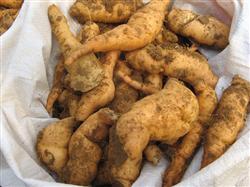
The harvesting method for Rehmannia is: use a shovel or sickle to cut off the stems and leaves of the aboveground part, taking care not to cut too deep so as not to damage the roots. After the aboveground part is cut off, use a rake to gather the cut stems and leaves to one side, exposing the soil surface to facilitate harvesting of the rhizomes. Use a shovel or pickaxe to dig at one end of the bed, with a ditch depth of about 35 cm; the digging depth should be such that the rhizomes are not damaged. Rehmannia breaks easily, so be very careful when digging, and also try to minimize damage to the rhizomes during the picking process.
2. Processing Rehmannia:
Place the Rehmannia rhizomes in the sun to dry. After drying for a period of time, when the Rehmannia is about 70 to 80 percent dry, pile them up and let them sweat for a few days to allow moisture to return. This makes the drying degree uniform. Then dry them in the sun again, continuing until the texture is soft and dry.
Because sunlight is weak in autumn and winter and drying is slow, it is not only time-consuming and labor-intensive, but the product also has low oiliness. Remove the soil from raw Rehmannia completely, wash it with water, put the washed Rehmannia into a basin, and mix it with yellow rice wine. The amount used should be just enough for the Rehmannia to be soaked in the yellow rice wine. Soak for half an hour, then put the soaked Rehmannia into a steamer, cover with the lid, and steam sealed. Pay attention to keeping the heat even. If the fire is put out midway or the temperature is too low, the internal juice of raw Rehmannia will flow out, affecting quality and medicinal properties.
Steam until the raw Rehmannia is black and moist inside and out, with no raw core, and has a special burnt aroma, then stop heating, take it out, and dry it in the sun on a bamboo mat or curtain; this is prepared Rehmannia.
Click to get more Rehmannia cultivation techniques
Click to get more medicinal herb cultivation techniques