How do you manage mint in everyday growing?
How do you manage mint in everyday growing? Please explain the daily management methods. The daily management of mint growing mainly includes thinning and gap filling, hoeing and weeding, water and fertilizer management, and pinching, etc. The operation methods are described in detail below for reference: Thinning and gap filling. To obtain a high yield, a certain density of plants must be maintained in the field...
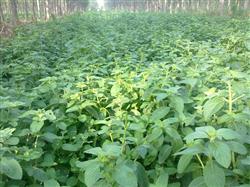 How do you manage mint in everyday growing? Please explain the daily management methods.
The daily management of mint growing mainly includes thinning and gap filling, hoeing and weeding, water and fertilizer management, and pinching, etc. The operation methods are described in detail below for reference:
Thinning and gap filling
To obtain a high yield, a certain density of plants must be maintained in the field. If the density is too high, the leaves on the lower part of the branches tend to fall off; if the density is too low, the basic number of seedlings is insufficient and the yield is limited. Therefore, work to even out dense areas and fill in sparse ones must be done well. Generally, for the first crop, keep 25,000 plants per mu, with a plant spacing and row spacing of 10cm to 13cm. After the first crop is cut, keep 50,000 plants for the second crop. To even out dense areas and fill in sparse ones, four requirements should be met: First, timing: carry it out when the first-crop seedlings are 12cm to 15cm tall, when the advantages and disadvantages of plant form are easy to distinguish; the underground rhizomes have not yet grown out, so they are easy to dig out completely; and the seedlings are smaller, so the transplant survival rate is high. Second, watch the weather: on cloudy days with wet soil, impurities can be dug out completely including the roots. Third, be careful: carefully identify from aspects such as plant form, color, and smell. Fourth, repeat: check frequently, pull out any impurity as soon as it is seen, and keep removing until none remain.
Hoeing and weeding
During the seedling stage, the temperature is relatively low, which favors weed growth. Take advantage of sunny days and carry out shallow hoeing and weeding 2 to 3 times before the rows close. Because mint rhizomes go shallow into the soil, shallow hoeing is suitable near the roots, and it may be slightly deeper between rows, but the underground rhizomes must not be injured by hoeing. Through hoeing and weeding, reduce soil moisture and nutrient consumption, raise soil temperature, improve aeration, and promote mint growth. Before harvest, pull weeds once more. After the first mint crop is harvested, use a hoe to shallowly hoe the bed surface once, hoe away the remaining stems and weeds, deepen and open the field ditches, and cover the bed surface with the ditch soil to help the second mint crop emerge and grow.
Fertilizing
Seedling-promoting fertilizer
After the mint recovers from transplanting and begins stem and leaf growth, apply 500kg of decomposed, finely crushed organic fertilizer per mu, or 10kg of NPK compound fertilizer, in opened holes, so that the seedlings have enough nutrients for healthy growth.
Branching fertilizer
Around the start of summer, the temperature rises, growth speeds up, photosynthesis is vigorous, leaves increase, and branching begins. When the seedlings are 12cm to 15cm tall, apply a heavy branching fertilizer once, and apply nitrogen, phosphorus, and potassium fertilizers in combination. Generally, use 25kg of high-quality compound fertilizer per mu, applied in opened holes or furrows between rows before rain. Chemical fertilizer must be applied after the dew has dried or before rain when there is no water on the leaves, to prevent fertilizer from sticking to the leaves and burning them. At the same time, note that nitrogen fertilizer alone must not be applied heavily, to prevent excessive stem and leaf growth, which can cause lodging later and affect yield.
Leaf-preserving fertilizer
In early June, the leaves gradually begin to mature. Based on growth vigor and appearance, apply an appropriate supplementary leaf-preserving fertilizer once. If growth is good, there is no need to apply it; if growth is poor, apply an appropriate supplement, and foliar spraying can also be used as a supplementary method. Quick-acting fertilizer should be applied 25d to 30d before harvest, and slow-release fertilizer 40d to 45d before harvest. Applying too early makes the plants prone to early senescence later, while applying too late makes them prone to staying green and maturing late, affecting yield and quality.
Water and fertilizer management
Mint rhizomes and fibrous roots go shallow into the soil and can tolerate neither waterlogging nor drought. If drainage in the mint field is poor, seedlings often emerge unevenly. After the rows close and before harvest, if there is continuous rainy weather, the plants are highly prone to disease and leaf drop. Therefore, ditch opening and drainage must be done carefully, so that the ground dries after rain and there is no standing water in the ditches. The stem and leaf growth period requires sufficient water. If there is drought and the soil is dry, light irrigation must be done.
If irrigation lasts too long, it easily causes root rot and seedling death. The high-temperature drought from July to August delays the emergence of the second mint crop and slows its growth. Timely watering is the key to achieving a high yield in the second crop. At noon during the dog days, the temperature is too high, so irrigation should be carried out in the early morning or evening, and it is best to irrigate and drain quickly. From 20d to 30d before harvest, irrigation should be stopped to let the soil dry appropriately, which helps the accumulation of nutrients and can prevent the plants from turning green again and delaying maturity.
Pinching
If the plants are very sparse and the density is low, pinch off the growing tip at noon on a sunny day in May, removing it from the top two layers of young leaves, and apply a quick-acting chemical fertilizer or human and livestock manure once to promote new shoots. Pinching is prohibited in plots with high density.
Click to get more mint growing techniques
Click to get more medicinal herb growing techniques