For sweet potatoes to yield high, the fertilization method is key
The demand of sweet potatoes for the three major elements nitrogen, phosphorus and potassium varies with the growth stage. Nitrogen fertilizer is absorbed more during the stem and leaf growth period and less during the tuber swelling period; phosphorus fertilizer is absorbed less in the middle stage of stem and leaf growth and more during the tuber swelling period; while potassium fertilizer absorption is greater than that of nitrogen and phosphorus from planting to harvest, and is even more pronounced during the tuber swelling...
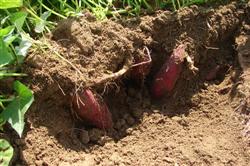
The demand of sweet potatoes for the three major elements nitrogen, phosphorus and potassium varies with the growth stage. Nitrogen fertilizer is absorbed more during the stem and leaf growth period and less during the tuber swelling period; phosphorus fertilizer is absorbed less in the middle stage of stem and leaf growth and more during the tuber swelling period; while potassium fertilizer absorption is greater than that of nitrogen and phosphorus from planting to harvest, and is even more pronounced during the tuber swelling period. Therefore, sweet potato fertilization should be carried out around this characteristic.
1. Apply sufficient base fertilizer. The base fertilizer should be mainly farmyard manure, supplemented by chemical fertilizer, and the farmyard manure must be fully decomposed. The amount of base fertilizer generally accounts for 60%-80% of the total fertilization amount. Generally speaking, for a yield of 2500-4000 kg of fresh tubers per 667 sq m, 3000-4000 kg of base fertilizer should be applied. In addition, apply 15-25 kg of superphosphate, 100-150 kg of plant ash, 6-10 kg of ammonium bicarbonate, etc. The base fertilizer should be applied in a concentrated, layered manner: 60% applied to the bottom layer during deep ploughing, and 40% applied in holes at planting. Quick-acting fertilizers used together with the base fertilizer should be applied in concentrated holes together with soil and miscellaneous manure, so that the sweet potato seedlings can absorb them as soon as they survive.
2. Topdressing according to the seedlings. The timing, type, amount and method of topdressing sweet potatoes should be determined according to the appearance and needs at different growth stages. Specifically, the "five fertilizers" should be well applied.
(1) Seedling-promoting fertilizer. The seedling-promoting fertilizer is generally a quick-acting fertilizer, applied 3-5 days after planting together with checking and replanting seedlings. The method is to open a hole of about 10 cm near the roots at the seedling hole, apply a small pinch of urea, that is, 1.5-3.5 kg per 667 sq m, then immediately water and cover with soil. A 1% urea solution can also be used to irrigate the roots, to make up for the shortage of quick-acting fertilizer and the slow fertilizer effect of the base fertilizer.
(2) Vine-strengthening fertilizer. After sweet potatoes enter the vine-strengthening stage, the underground part grows vigorously, the tubers begin to form, and the ability to absorb fertilizer is strong. To accelerate the expansion of leaf area and improve photosynthetic efficiency, the vine-strengthening fertilizer should be well applied 30-40 days after planting. The amount of fertilizer is determined by soil fertility and seedling vigor; apply more where growth is poor, topdressing 7.5-10 kg of ammonium sulfate or 3.5-4.5 kg of urea or 4.5-6 kg of ammonium nitrate, and 10 kg of potassium sulfate or 100 kg of plant ash per 667 sq m. Where growth is better, the amount can be reduced. Along with fertilization, timely cultivation, weeding, irrigation and drought prevention should also be done well.
(3) Tuber-promoting fertilizer. The tuber-promoting fertilizer should be mainly potassium fertilizer, generally applied 90-100 days after planting. Applying potassium during the tuber-promoting period can effectively prolong the functional period of leaves, enhance the vigor of stems and leaves, improve photosynthetic efficiency, promote the transport of photosynthetic products, and promote tuber swelling. Generally, 10 kg of potassium sulfate per 667 sq m can be used, or 100-150 kg of plant ash. After application, water once to promote the fertilizer effect as quickly as possible.
(4) Crack fertilizer. For sweet potatoes showing an obvious trend of premature senescence during the swelling period, skilfully applying crack fertilizer has a significant yield-increasing effect. The crack fertilizer is generally 4-6 kg of ammonium sulfate per 667 sq m, diluted with 400-600 kg of water, or 250 kg of decomposed human and animal urine, diluted with 750 kg of water, applied by pouring along the cracks.
(5) Foliar fertilizer. In the middle stage of tuber swelling, the fertilizer-absorbing function of the root system begins to decline. At this time, the method of topdressing outside the roots should be used to supplement fertilizer. Generally, a 2%-5% superphosphate extract or a 1% potassium phosphate solution or a 0.3% potassium dihydrogen phosphate solution or a 5%-10% filtered plant ash liquid is used, sprayed after 3 p.m., with 75 kg of liquid sprayed per 667 sq m, once every 15 days, for 2 consecutive sprays.
Notes: 1. Sweet potato is a chlorine-sensitive crop, so when choosing fertilizers, do not use fertilizers containing chlorine; 2. Ammonium bicarbonate should not be broadcast or surface-applied, but can be made into mixed fertilizer granules for deep application; 3. Human and animal urine and manure should be fully decomposed when applied; 4. Plant ash cannot be mixed with nitrogen and phosphorus fertilizers and should be applied separately.