Detailed Explanation of Key Techniques for Winter Lettuce Cultivation
Variety Selection: Choose mid-to-late maturing heading lettuce varieties with strong cold resistance for cultivation. Cultivation Dates: For solar greenhouse cultivation, planting can be done from mid-to-late November to late January, with harvest from early-to-mid January to early March. Seedling Raising: Choose fertile sandy loam soil, break it up finely, and make flat beds. Then apply 1... of screened high-quality manure per 10 sq m...
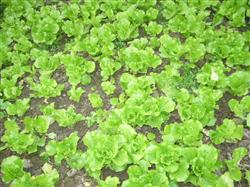
Variety Selection: Choose mid-to-late maturing heading lettuce varieties with strong cold resistance for cultivation. Cultivation Dates: For solar greenhouse cultivation, planting can be done from mid-to-late November to late January, with harvest from early-to-mid January to early March.
Seedling Raising: Choose fertile sandy loam soil, break it up finely, and make flat beds. Then apply 100 kg of screened high-quality manure and 0.5 kg of monopotassium phosphate per 10 sq m, mix thoroughly, level the bed surface, and water. After the water seeps down, scatter the seeds. Generally, dry seeds are sown, but seeds can also be soaked and pre-germinated before sowing. For dry seed sowing, first treat the seeds with 75% chlorothalonil wettable powder equal to 0.3% of the seed weight, but it should not be left for too long. For soaking and pre-germination, first soak in warm water at 20°C for 6-7 hours, remove and wrap in a cloth bag, place at 20°C to germinate, rinse once daily with clean water, and sprouts will be fully ready after 2-3 days. Sow on a windless, sunny morning, sowing 3-5 grams of seed per sq m of seedling bed. After sowing, cover with a 3-5 mm layer of fine soil.
Land Preparation and Fertilization: Before planting, apply 5000 kg of decomposed organic fertilizer and 30-40 kg of compound fertilizer per mu. After deep plowing, make flat beds; for plastic film mulching, small raised beds can be made. Planting: For solar greenhouse cultivation, the row spacing is generally 40 cm and plant spacing 30 cm. Water before lifting seedlings and cut into blocks, keeping more soil around the roots. Plant in furrows or holes, close the furrows and level the beds, then water thoroughly after planting.
Post-Planting Management: After planting, maintain daytime temperatures at 20°C-24°C and nighttime temperatures above 10°C. During the seedling recovery period, cultivate and loosen the soil 1-2 times. After seedling recovery, lower the temperature appropriately, with 15°C-20°C suitable during the day, and water 7-10 days after seedling recovery while lightly applying chemical fertilizer, about 10 kg per mu. Then cultivate again and appropriately control growth. After about 15 days, when the rosette leaves have grown and the heart leaves begin to head, apply 15-20 kg of compound fertilizer or ammonium nitrate, and apply fertilizer once more during the heading stage. In winter, watering should not be too frequent to prevent lowering soil temperature or causing excessive humidity. During the heading stage, water supply should be uniform; avoid alternating drought and moisture, which can cause head cracking or spreading growth of head leaves. Stop watering 3-5 days before harvest.