How to fertilize head lettuce? Detailed explanation of nutrient requirements and fertilization techniques
Nutrient requirements Head lettuce is a herbaceous plant of the genus Lactuca in the Asteraceae family, suited to slightly acidic clay loam or soil rich in organic matter with strong water- and fertilizer-retention capacity. The growth cycle of head lettuce can be divided into the germination stage, seedling stage, rosette stage and head-forming stage. It is generally believed that every 1000 kg of head lettuce requires the absorption of 3.7 kg of nitrogen (N), ...
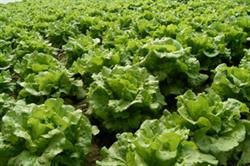
Nutrient requirements Head lettuce is a herbaceous plant of the genus Lactuca in the Asteraceae family, suited to slightly acidic clay loam or soil rich in organic matter with strong water- and fertilizer-retention capacity. The growth cycle of head lettuce can be divided into the germination stage, seedling stage, rosette stage and head-forming stage.
It is generally believed that every 1000 kg of head lettuce requires the absorption of 3.7 kg of nitrogen (N), 1.45 kg of phosphorus (P205) and 3.28 kg of potassium (K20). Head lettuce grows rapidly and favors nitrogen fertilizer; nutrient uptake is relatively small in the early growth stage, and after 70~80 days from sowing it enters the head-forming stage, when nutrient absorption increases sharply. During the one month of the head-forming stage, nitrogen absorption can account for more than 80% of the whole growth period. The absorption of phosphorus and potassium is similar to that of nitrogen, especially potassium absorption, which is not only large in amount but also continues until harvest. Phosphorus deficiency at the seedling stage has the greatest impact on growth, and phosphorus deficiency at the head-forming stage will affect head formation in lettuce. Potassium deficiency at the head-forming stage severely affects leaf weight.
Fertilization techniques For the whole growth period of head lettuce, the fertilization amount per mu is 2500~3000 kg of farmyard manure (or 350~400 kg of commercial organic fertilizer), 14~17 kg of nitrogen fertilizer (N), 6~8 kg of phosphorus fertilizer (P205) and 11~13 kg of potassium fertilizer (K20). Organic fertilizer is applied as base fertilizer; nitrogen and potassium fertilizers are divided between base fertilizer and topdressing; phosphorus fertilizer is all applied as base fertilizer. Chemical fertilizers and farmyard manure (or commercial organic fertilizer) are applied mixed together.
Base fertilizer For the base fertilizer, apply 2500~3000 kg of farmyard manure per mu (or 350~400 kg of commercial organic fertilizer), 4~5 kg of urea, 13~17 kg of diammonium phosphate and 7~8 kg of potassium sulfate. In cases of calcium-deficient soil, apply 20 kg of calcium nitrate per mu to calcium-deficient soil.
Topdressing Rosette stage topdressing: apply 6~8 kg of urea and 5~6 kg of potassium sulfate per mu.
Early head-forming stage topdressing: apply 9~12 kg of urea and 6~7 kg of potassium sulfate per mu.
Mid head-forming stage topdressing: apply 6~8 kg of urea and 5~6 kg of potassium sulfate per mu.
Foliar topdressing During the head-forming stage, spray a 0.2% potassium dihydrogen phosphate solution on the leaves 2~3 times. In cases of calcium-deficient soil, spray a 1% calcium nitrate solution on the leaves during the rosette stage, spraying continuously 3 times, once every 7 days, and stop spraying after the rosette stage ends. In protected cultivation, carbon dioxide gas fertilizer can be added.