What are the common diseases of lettuce? Detailed explanation of control methods
When lettuce is grown in greenhouses in winter, it is prone to a variety of diseases. Several common diseases of lettuce and their control measures are summarized as follows: Sclerotinia rot mainly affects the base of the stem. In the early stage of the disease, the affected part is yellow-brown to brown and water-soaked, then spreads to the entire stem, causing the stem to rot or spreading upward to cause leaf rot, and finally the plant withers...
When lettuce is grown in greenhouses in winter, it is prone to a variety of diseases. Several common diseases of lettuce and their control measures are summarized as follows:
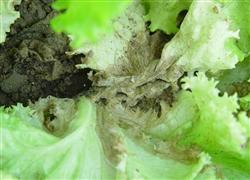
Sclerotinia rot mainly affects the base of the stem. In the early stage of the disease, the affected part is yellow-brown to brown and water-soaked, then spreads to the entire stem, causing the stem to rot or spreading upward to cause leaf rot, and finally the plant withers and dies. When humidity is high, dense white cottony mycelial masses are produced, which later become black sclerotia shaped like mouse droppings.
Control methods: After harvest, thoroughly remove diseased residues and fallen leaves, and carry out deep plowing. Plant at a reasonable density to reduce field humidity. Before transplanting, spray the planting holes with 25% triadimefon wettable powder. For chemical control, spray with 40% flusilazole emulsifiable concentrate at 3000 times dilution, 50% iprodione wettable powder at 1500 times dilution, or 25% prochloraz emulsifiable concentrate at 1000-1500 times dilution, focusing on the stem base and basal leaves, spraying once every 7-15 days, for 2-3 consecutive sprays.
Downy mildew mainly affects leaves, usually starting on the lower leaves first and gradually spreading upward. In the early stage, pale yellow nearly round or polygonal lesions appear on the leaves. When moist, white mold grows on the lesions on the underside of the leaves, and in severe cases the mold spreads to the upper surface of the leaves. Later, the lesions join together and turn yellow-brown, and the plant dies.
Control methods: After harvest and before transplanting, thoroughly clean up diseased residues and fallen leaves, plant at a reasonable density, strictly prohibit flooding irrigation, drain promptly after rain, and reduce field humidity. For control agents, use 72.2% propamocarb at 600 times dilution or 50% dimethomorph at 1500 times dilution, spraying the undersides of the leaves, at an interval of 7 days, for 2-3 consecutive sprays.
Gray mold can occur at the seedling stage and the adult plant stage. When it occurs at the seedling stage, the affected stems and leaves rot in a water-soaked manner. When it occurs at the adult plant stage, it starts from the leaves near the ground, initially showing irregular water-soaked lesions, which later expand and turn brown, with the base appearing reddish-brown. In severe cases, rot proceeds upward from the base, and the stems and leaves wilt. When humidity is high, gray-brown or gray-green mold grows on the affected parts. When the weather is dry, the diseased plants gradually dry up and die, and the mold changes from white to gray to green.
Control methods: Strengthen management at the adult plant stage, increase ventilation, and reduce air humidity as much as possible. Once diseased plants are found, remove them promptly and take them out of the greenhouse for destruction. Before transplanting, use 50% procymidone wettable powder at 1000 times dilution to spray the greenhouse soil, walls, greenhouse film, and other surfaces for surface sterilization. For chemical control, use Enzeimei at 1000 times dilution, Shijiale at 500 times dilution, etc., once every 7 days, for 2-3 consecutive sprays.
Leaf scorch mainly affects leaves, mostly starting from the edges of outer leaves or heart leaves. In the early stage of infection, brown necrotic patches appear on the leaf edges. As the disease develops, the leaf edges become scorched, the leaf color fades, and finally all the leaves wilt and die.
Control methods: Keep the soil moist and at suitable water content, prevent field temperatures from being too high or too low, advocate the use of enzyme bacterial fertilizer, improve the physical and chemical properties of the soil, and avoid excessive watering and fertilization. For chemical control, use 14% copper teraphthalate aqueous solution at 350 times dilution, 72% agricultural streptomycin sulfate at 2000 times dilution, etc., spraying once every 7 days, for 2-3 consecutive sprays.