High-Yield and High-Efficiency Cultivation Model and Techniques for Spring Soybean Intercropped with Corn and Relay-Cropped with Sweet Potato
Right now is the sowing season for spring soybean and spring corn. Experts from the Provincial Department of Agriculture remind that the sowing window for spring soybean and spring corn spans a long period, the weather changes rapidly, and sowing conditions vary greatly, so it is not advisable to sow prematurely. The suitable sowing period is from late March to mid-May. Under conventional cultivation, our province...
 1. Adapt to local conditions and select good varieties
Ningyuan County belongs to the subtropical monsoon humid zone. Due to the influence of terrain and landforms, vertical differences are obvious, and dryland is mostly distributed in mountainous areas with relatively little light. From March to April, cloudy and rainy weather with little sunshine and frequent cold waves are unfavorable for the emergence of soybean (4556, 6.00, 0.13%) and corn (2345, -9.00, -0.38%) seedlings. Sudden summer and autumn droughts occur, and dryland basically has no irrigation conditions, which is unfavorable for corn tasseling, silking, and grain filling. In particular, autumn drought has a major impact on the expansion of sweet potato storage roots. Therefore, for corn and soybean, varieties with a moderate growth period, high yield, drought tolerance, and strong stress resistance should be selected. For sweet potato, varieties with drought tolerance, high yield, and high starch content should be selected. At present, corn varieties can include Denghai 9, Nongda 108, Denghai 11, Jundan 20, etc. Spring soybean can include Xiangchundou 19, Xingnong 2, Cuishan, Guizaodou 1, etc. Sweet potato can include Xiangshu 15, Xiangshu 16, Yushu 868, Xiangfu 1, Nanshu 88, etc.
2. Finely prepare the soil and apply sufficient base fertilizer
Corn, soybean, and sweet potato are all dryland crops. In addition, spring and summer rainfall in our county is concentrated, and poor drainage easily causes waterlogging damage, seed rot, and missing seedlings. Soybean in particular requires smooth field drainage and suitable soil moisture content. Too dry is unfavorable for seedling emergence, while too wet causes seed rot and yellowing of leaves. It also requires loose soil, which is conducive to soybean cotyledon emergence and rhizobia activity. In recent years, poor emergence and poor stand establishment of soybean in many places have mainly been due to rough cultivation, temporary plowing, plowing and sowing at the same time, and wet plowing and wet sowing. Therefore, early plowing must be carried out, preferably deep plowing before winter, allowing the soil to sun and freeze, and drainage ditches should be opened in low-lying areas. Before sowing, shallow plow once, open beds at 2.5 m, with a bed surface width of 2.1 m and a bed ditch width of 0.4 m. At the same time, apply sufficient base fertilizer at the rate of 15 tons of farmyard manure per hectare, 150 kg of urea, and 600 kg of phosphate fertilizer (preferably calcium magnesium phosphate).
3. Sow at the right time and plant in a standardized way
In order to achieve high yield throughout the year, timely early sowing of the first-season corn and soybean is very important. The principle is to make full use of local temperature, light, and climate resources to achieve high yield in both seasons, while also preventing the harm of low-temperature cold waves in early spring to corn and soybean emergence and stand establishment, and resolving the contradiction that sweet potato yields are affected by either too long a symbiotic period with soybean and corn due to early transplanting or by being too late. According to the climate characteristics of our county, the best sowing period for soybean and corn is in mid-to-late March. Corn and soybean should be sown simultaneously on sunny days around the Spring Equinox. Sweet potato should be relay-cropped in the reserved rows for soybean from late May to early June, with a symbiotic period with soybean and corn of about 40 days.
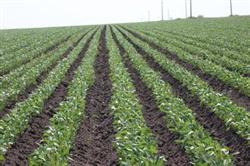
Corn is a tall-stalked crop. When intercropping and relay-cropping with soybean and sweet potato, the bed-separated cultivation specifications must be standardized to give full play to the yield-increasing capacity of each crop. In particular, the corn planting population must not be too large, which would affect the growth of soybean and sweet potato, nor too sparse, which would affect the yield potential of corn. The specific method is as follows: east-west row orientation is required, beds are opened at 2.5 m, the bed surface width is 2.1 m, and the bed ditch width is 0.4 m. On one side of the bed, plant 1 row of corn, with a corn plant spacing of 20 cm, sowing 3 corn seeds per hole and keeping two seedlings, ensuring about 37,500 corn plants per hectare. Soybean is sown in wide-narrow rows, with 7 rows of soybean per bed. The soybean row near the corn is 30 cm wide, and the general row spacing between soybean rows is 33 cm, with a plant spacing of 20 cm, depending on the characteristics of different soybean varieties. Plant 90,000-120,000 soybean hills per hectare, sow 3-4 soybean seeds per hill, and ensure about 360,000 seedlings per hectare. Sweet potato should be relay-cropped 35-40 days before the harvest of corn and soybean, at a plant-row spacing of 33 cm x 40 cm, in the reserved soybean rows and between soybean and corn.
4. Improve sowing quality and ensure full stand establishment in one sowing
Full stand establishment in one sowing is the foundation of high and stable yield. In particular, good uniformity of corn can avoid the yield-reducing phenomenon in which large seedlings suppress small seedlings, strong seedlings suppress weak seedlings, and plants are uneven in height. To ensure full stand establishment in one sowing, do the following: carefully select seeds before sowing, remove broken, rotten, and moldy seeds, and ensure the use of standard seeds with a germination rate above 85%. At the same time, carry out rodent control to reduce rodent damage. After sowing soybean and corn, cover the seeds with 750 kg of phosphate fertilizer mixed with 15 tons of high-quality burnt soil ash per hectare. During sowing, avoid direct contact between seeds and chemical fertilizers. Spring sowing should be shallow, the seed-covering ash should not be too thick, and the soil should be dry and refreshing to facilitate seed germination.
5. Strengthen management and ensure a bumper harvest
(1) Check seedlings and fill gaps, thin and space seedlings
After soybean and corn emerge, if missing seedlings are found, reseeding should be done in time. The reseeded seeds can first be soaked in water for about 3 hours. In dry weather, reseeding should be done with water to ensure emergence on schedule. It is best to use pre-grown reserve seedlings for transplanting. Another method is to reserve seedling beds at the field edges and corners according to 10% missing seedlings in the soybean and corn planting area, with field sowing and seedling-bed raising carried out at the same time, making it convenient and simple to check seedlings and fill gaps. Sweet potato should be checked for missing hills and filled within 3-5 days after planting. According to surveys, some farmers have adopted the method of increasing sowing rate to ensure full stands of corn and soybean, resulting in too many seedlings per hill or even clustered growth. Excess seedlings must be thinned and spaced. Corn should be thinned at the 3-leaf stage after emergence. Soybean should be thinned from cotyledon expansion to the appearance of true leaves, with a seedling spacing of about 3 cm and 2-3 seedlings per hill being appropriate.
(2) Cultivate and earth up, and skillfully apply topdressing
After soybean and corn emerge, cultivation should be carried out 2-3 times. Soybean in particular grows slowly at the seedling stage, and weeds are likely to grow, so timely repeated cultivation, loosening of soil, and weeding should be carried out to promote root development and also to drain and store water. For corn, after weeding and before tasseling, shallow cultivation should be combined with earthing up to prevent lodging. For soybean, before flowering, cultivation should be combined with earthing up. For sweet potato, after harvesting corn and soybean, the soil in the corn and soybean rows should be dug and turned immediately. At the same time, about 15 tons of barnyard manure per hectare should be used as base fertilizer, and combined with cultivation and earthing up, ditches should be opened and ridges made.
Topdressing should emphasize "skillful application" and "appropriate application." After corn emerges, in combination with cultivation, apply 1,500-2,250 kg of diluted human manure per hectare as seedling fertilizer, and heavily apply ear fertilizer, mainly nitrogen fertilizer. For soybean, apply seedling fertilizer and flower-pod fertilizer early, and thoroughly change the practice of "soybean can fix nitrogen, so no nitrogen fertilizer is needed." The improved soybean varieties currently promoted, such as Xingnong 2, Cuishan soybean, and Xiangchundou 19, have much higher yields than farm varieties, and their demand for nitrogen fertilizer is also much higher. Nitrogen must be supplemented in time to obtain high yield. The method is as follows: at the seedling stage before soybean rhizobia have formed, apply 75-112.5 kg of urea per hectare, and apply a little more on plots with poor soil fertility. Apply flower-pod fertilizer in time 5-7 days before flowering, applying 112.5-150 kg of 45% ternary compound fertilizer per hectare. Also attach importance to the application of micronutrients, combined with plant hormones, and foliar spray of paclobutrazol and potassium dihydrogen phosphate to reduce flower and pod shedding and increase the pod-setting rate per plant. Topdressing for sweet potato should focus on the later stage. Generally, foliar spray with potassium dihydrogen phosphate is applied 2 times. For poor growth, 1-2% urea solution can be added. The cost is low, the operation is easy, and the effect is good.
(3) Timely control of diseases and pests
For corn, focus on the control of one insect and one disease, namely corn borer and sheath blight. When corn is at the trumpet stage and 5-10% of plants show small spots or "mosaic" on the heart leaves, pesticides such as fipronil or carbofuran can be mixed with fine soil and applied to the whorl to control corn borer damage. When 15% of corn plants show sheath blight on the lower part, use jinggangmycin for control, and apply again about 10 days later. Soybean is highly susceptible to damage by pod borer and soybean pod borer 3-5 days after flowering, so timely control is necessary. Generally, use 100 g of 40% dimethoate mixed with 60 kg of water, or spray with 90% crystalline trichlorfon at 800 times dilution, for 2-3 consecutive times, with an interval of 5-7 days each time. For aphids, omethoate can be used for control.
(4) Protect stems and leaves and assist pollination
Corn is planted along the working rows. During agricultural operations, be careful not to damage the stems and leaves. Removing old leaves in the later growth stage of corn is beneficial for ventilation and light penetration. Detasseling and artificial pollination during the flowering period of corn have a good yield-increasing effect. The operation method is as follows: when the corn tassel is 1/3 exposed, pull out the tassel every other plant. When the ear is at the full silking stage, shake the plants at 9-10 a.m. for artificial pollination, once every 2-3 days, for 2-3 consecutive times.
Cultivation of sweet potato should be carried out before the rows close. After the rows close, do not turn or lift the vines, so as not to disrupt the balanced distribution of vines and leaves, damage the vines and leaves, reduce photosynthetic efficiency, affect storage root expansion, and cause yield reduction.
(5) Harvest at the right time
When corn ears, stems, and leaves turn white, and when most soybean leaves are dry and shed, the pods are grass-withered in color, the seeds separate from the pod walls, and the seeds are semi-dry but not hard so that the plants rattle when shaken by hand, harvest should be carried out in time to facilitate sweet potato production. Sweet potato has no obvious growth termination period, and extending the growth period can increase yield, but harvesting should be completed before low-temperature frost damage arrives.