What kind of disease is sorghum black head mold root rot
Symptoms The disease can occur at the seedling stage and the adult plant stage. Infected seedlings show wilting that resembles water deficiency; the cortex and vascular bundles of diseased seedlings are brown and water-soaked, and the fine roots soften and rot. Infected adult plants have drooping and slightly curled leaves, older leaves turn yellow, and drying begins from the leaf tips and leaf margins. When the roots are infected, the roots and root crown turn brown and rot. Pathogen...
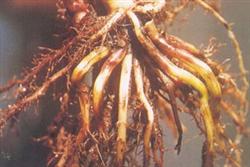
Symptoms The disease can occur at the seedling stage and the adult plant stage. Infected seedlings show wilting that resembles water deficiency; the cortex and vascular bundles of diseased seedlings are brown and water-soaked, and the fine roots soften and rot. Infected adult plants have drooping and slightly curled leaves, older leaves turn yellow, and drying begins from the leaf tips and leaf margins. When the roots are infected, the roots and root crown turn brown and rot.
Pathogen Periconia circinata (Mangin) Sacc., called sorghum black head mold, is a fungus of the subphylum Deuteromycotina. The conidiophores are erect, borne in groups of 2-3 or singly, brown to dark brown, thick-walled, measuring 150-300 x 6-8 (um), spirally twisted near the apex, with the apical cell enlarged, bearing 3 conidiogenous cells on it; the apical cell can divide, and each division forms 1 conidiogenous cell, on which conidia are borne in chains. The conidia are densely clustered into a head-like mass, black, spherical, with a smooth or spiny surface, 12-27 um in diameter.
Transmission routes and disease conditions The fungus is a saprophyte and can induce disease in the aboveground parts or roots of plants.
Control methods (1) Implement crop rotation for more than 3 years. (2) Strengthen management, use appropriate density, adopt high-ridge or high-bed cultivation, and do not plant sorghum in low-lying land. (3) Apply fully decomposed organic fertilizer or compost fermented with Japanese enzyme bacteria, drain promptly after rain, and strictly prohibit flood irrigation.