How to Grow Ginger for High Yields? Six Key Cultivation Measures Explained
1. Choose the site carefully and avoid continuous cropping. Ginger is prone to soft rot, commonly known as ginger blast, in hot and humid environments. Ginger blast is a bacterial soil-borne disease that becomes severe with continuous cropping and causes major yield losses. Because ginger is susceptible to this devastating disease, it should not be grown continuously; instead, it should be rotated with rice, cruciferous crops...
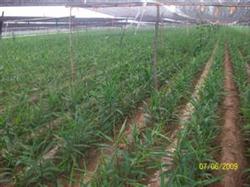
I. Choose the site carefully and avoid continuous cropping.
Ginger is prone to soft rot, commonly known as ginger blast, in hot and humid environments. Ginger blast is a bacterial soil-borne disease that becomes severe with continuous cropping and causes major yield losses. Because ginger is susceptible to this devastating disease, it should not be grown continuously; instead, it should be rotated with rice, cruciferous crops and leguminous crops for 3-4 years. For growing ginger, it is best to choose fertile loam or sandy loam with deep soil and abundant organic matter. The field should be slightly elevated, with convenient drainage and irrigation and no tendency to waterlog, which is relatively favorable for preventing ginger blast.
II. Disinfect and sprout the seed ginger to promote early growth.
For planting ginger, choose fully mature, plump old ginger with 1-2 strong buds and no disease as seed ginger. Before sowing, the seed ginger needs to be disinfected and sprouted. There are many disinfection methods; soaking the seed ginger in Bordeaux mixture at 1:1.5:120 for 20 minutes can kill the pathogens on the surface of the seed ginger. After disinfection, sun-dry the seed ginger for 2-3 days; once the surface moisture of the ginger pieces has disappeared, pile them up and cover with straw or burlap for warmth to promote sprouting, keeping them moist at 20-25°C. When the ginger sprouts reach 1 cm, they can be planted.
III. Sow at the right time and plant at a reasonable density.
In South China, ginger is generally sown from February to March. The seed ginger should preferably weigh 70-100 g. A row spacing of 40 cm and a plant spacing of 20-25 cm is best for seed ginger density.
IV. Apply plenty of base fertilizer and top-dress scientifically.
Ginger is fairly tolerant of fertilizer and has a long growing period, so the principle of applying plenty of base fertilizer and top-dressing multiple times should be adopted. Apply 1500-2500 kg of pig and cattle manure and 10-15 kg of potash fertilizer per mu as base fertilizer. Top-dressing should be applied frequently and lightly, from dilute to concentrated. Apply a light fertilizer once when the seedlings are 15 cm tall, and a second top-dressing when the seedlings are 30 cm tall. After that, apply top-dressing about once every 20 days. During the seedling stage, nitrogen fertilizer should be the main type, while during the rhizome enlargement stage, more potash fertilizer should be applied.
V. Shade and cool the plants to promote growth.
Ginger is a shade-tolerant plant that cannot tolerate high temperatures and strong light; scattered light is favorable for its growth. Therefore, shading should be provided during the summer growing period to promote growth. There are many shading methods: it can be intercropped with crops such as winter melon, kudzu and taro, using these crops for shade. A flat frame covered with shade netting can also be used for shading.
VI. Prevent drought and waterlogging, and earth up in time.
Ginger is neither drought-tolerant nor waterlogging-tolerant, and has strict water requirements. During the growing period, it is best to keep the soil moist. During the high-temperature summer period, water should be applied in time to lower the temperature, preferably in the early morning and evening. On rainy days, standing water in the field should be drained in time to reduce the occurrence of ginger blast. The growth of ginger rhizomes requires a dark, moist environment; as the rhizomes grow upward, they easily become exposed above the ground, the skin thickens and the quality deteriorates. Therefore, earthing up is necessary. Generally, earthing up is done about three times. The depth of earthing up can be determined according to the cultivation purpose. If harvesting young ginger, earth up deeper to increase the length of the young ginger and make it crisp and tender. If harvesting old ginger, earth up shallower to make the rhizomes thick and mature.