Detailed Explanation of Key Points for the Prevention and Control of Soybean Gray Leaf Spot
1. Symptoms: It mainly damages the leaves of adult plants and also infects seeds, seedlings, stems, and pods. On the cotyledons of seedlings grown from diseased seeds, round brown lesions appear. Later, irregularly shaped lesions may also form. When humid, the central part of the lesions on the underside of the leaves mostly produces a gray mold layer, which is the pathogen's conidia. 2. Control methods: ...
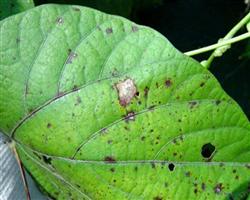
1. Symptoms: It mainly damages the leaves of adult plants and also infects seeds, seedlings, stems, and pods. On the cotyledons of seedlings grown from diseased seeds, round brown lesions appear. Later, irregularly shaped lesions may also form. When humid, the central part of the lesions on the underside of the leaves mostly produces a gray mold layer, which is the pathogen's conidia.
2. Control methods:
(1) In areas with relatively humid and rainy seedling stages, use 50% thiram for seed dressing, with 0.4 kg of the chemical per 100 kg of seeds.
(2) For susceptible varieties and densely growing soybean fields, spray chemicals at the early stage of disease onset or during the pod and susceptible stages to control lesions on the seeds as much as possible. Commonly used chemicals include 40% carbendazim suspension concentrate at 100 g per mu, or 50% thiophanate-methyl at 100 g, diluted with 80 kg to 100 kg of water for spraying. Depending on disease development, spray 2 to 3 times in total at intervals of 7 to 10 days.