Sunflowers damaged by the white-spotted flower chafer: how to control them effectively?
Damage characteristics: Adults feed on the flowers of sunflowers, corn, vegetables, and fruit trees. When damaging corn, adults feed on the silks; when damaging sunflowers, they feed on the flower heads, causing the heads to rot. Morphological characteristics: Adults are 17-24 mm long and 9-12 mm wide. Oval-shaped, with a bronze or copper-green luster, and the body surface is scattered with numerous irregular white felt spots. The clypeus...
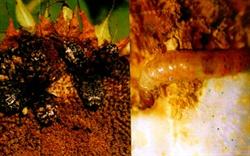
Damage characteristics: Adults feed on the flowers of sunflowers, corn, vegetables, and fruit trees. When damaging corn, adults feed on the silks; when damaging sunflowers, they feed on the flower heads, causing the heads to rot.
Morphological characteristics: Adults are 17-24 mm long and 9-12 mm wide. Oval-shaped, with a bronze or copper-green luster, and the body surface is scattered with numerous irregular white felt spots. The front edge of the clypeus is turned upward, concave in the middle, with a border on both sides, and the outer sides slope downward; the antennae are dark brown; the compound eyes protrude; the pronotum has irregular white felt spots and is concave in the middle of the posterior margin; between the posterior angle of the pronotum and the anterior angle of the elytra there is a very prominent triangular piece, namely the posterior lateral plate of the mesothorax; the elytra are broad, nearly rectangular, covered with coarse punctures, and the white felt spots are mostly in transverse wavy shapes; the pygidium is short and broad, with 3 white felt spots on each side arranged in a triangle; abdominal sternites 1-5 have white felt spots on both sides; the legs are relatively stout, with white felt spots on the knees; the posterior outer apical angle of the hind coxa is sharp; the outer edge of the fore tibia has 3 teeth, and the apex of each tarsus has 2 curved claws.
Life habits: One generation occurs per year. Adults begin to appear in early May, and June-July is the peak period of occurrence. Adults are active during the day, have a habit of playing dead, are attracted to the smell of wine and vinegar, are strong fliers, and often gather in groups to damage the flowers of vegetable crops grown for seed and corn silks, laying eggs in the soil. Larvae mostly feed on decaying matter and move by carrying themselves on their backs.
Control methods: (1) See the northeastern black chafer. (2) During the initial occurrence period of the white-spotted flower chafer, hang narrow-mouthed bottles on sunflowers, corn, or nearby trees. Wine bottles or cleaned empty pesticide bottles can be used. Hang the bottles at a height of 1-1.5 m, and place 2-3 white-spotted flower chafers in the bottles. When the white-spotted flower chafers in the field fly onto the bottles, they will first crawl near the bottle mouth and then fall into the bottle. Per 667 sq m, 40-50 bottles can be hung to trap and kill the white-spotted flower chafers, with excellent results.