Detailed Explanation of Key Techniques for High-Yield Sunflower Cultivation
Environmental Requirements Sunflowers have strong tolerance to low temperatures at both the seedling and mature stages. Seeds begin to swell and germinate at 2°C-4°C, can germinate at 4°C, can emerge at 5°C, and 8°C-10°C is sufficient for normal emergence. Seedlings can withstand several hours at -4°C and can still recover after the low temperature...
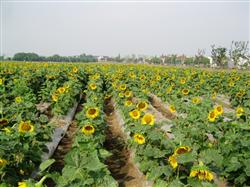
Environmental Requirements Sunflowers have strong tolerance to low temperatures at both the seedling and mature stages. Seeds begin to swell and germinate at 2°C-4°C, can germinate at 4°C, can emerge at 5°C, and 8°C-10°C is sufficient for normal emergence. Seedlings can withstand several hours at -4°C and can still recover normal growth after the low temperature, showing strong cold resistance. When the temperature is as high as 50°C and the relative humidity is 30%-55%, they can still carry out normal physiological activities by regulating body temperature through leaf transpiration. However, if the temperature is above 40°C and the relative humidity reaches 90% at the same time, growth stops, disease resistance weakens, and leaf spot and rust diseases occur. Land Preparation and Sowing Before planting, apply 15-20 tons of high-quality farmyard manure per hectare. Sunflower sowing time is from late March to mid-April. Direct sowing or seedling transplanting can both be used, with a planting density of 65 cm x 60 cm, one plant per hole. Replanting and Thinning Sunflower seedlings transplanted with soil have a survival rate of over 90%. Replanting should be done early and with small seedlings, preferably at 1-2 pairs of true leaves when the seedlings are no more than 15-20 cm tall, with plants set according to row and plant spacing, one plant per hole. Cultivation and Weeding Generally 3 cultivations are carried out. The first is hand hoeing to thin seedlings and remove weeds; the second combines weeding with final thinning and cultivation when seedlings are 50 cm-60 cm tall, and earthing up to form ridges to prevent lodging. The herbicide "trifluralin" is effective against narrow-leaf weeds; use 300 g per mu mixed with 20 kg of water, spray 10 days before sowing, and harrow it into the soil layer 10 cm deep to avoid herbicide damage to seedlings; 50% prometryn is effective against broadleaf weeds; use 200 g per mu mixed with 20 kg of water, spray within 3 days after sowing, and it can kill germinating weeds. Pruning Branches and Controlling Growth Early pruning can be used to control unlimited branch growth, with reasonable topdressing. Applying nitrogen and potassium fertilizer at 7-8 pairs of true leaves gives good results. For fields where no base fertilizer was applied at sowing, topdressing must be done early. At the first cultivation, apply 12-15 kg of ammonium nitrate, or 25 kg of ammonium bicarbonate, or 8 kg of urea plus 15 kg of potassium chloride. Supplementary Pollination Sunflowers do not set seed from self-pollination; they can only set seed through artificial supplementary pollination or cross-pollination by insects. Otherwise, empty seeds account for 35%-50%, and in severe cases the entire head is empty. (1) Artificial pollination: use cotton as a pollen puff to help pollen from different flower heads spread to each other on the heads. This can increase the seed-setting rate by more than 30%. (2) Bee pollination. During full bloom, when the temperature is around 28°C and there is no strong wind or rain, releasing bees for pollination can increase the seed-setting rate by about 40%. (3) During the seed-setting period, fertilizer and water should be supplied reasonably, with more potassium and phosphorus applied. Disease and Pest Control If leaf spot or rust occurs, spray with 15% triadimefon wettable powder at 1500 times dilution; about 10 days after pollination, spray with 40% dimethoate emulsifiable concentrate at 1000 times dilution or 20% Abamectin No. 2 at 1500 times dilution to control aphids, mites, and other pests. Harvesting and Seed Saving When the small florets in the center of the sunflower head wither and the seeds turn black, this indicates maturity, and they can be harvested in good time. Select heads that are large, from short plants, with thick stems, free of pests and diseases, and with plump seeds for seed. Place the seed heads for 3-5 days, then thresh and dry them in the sun.