Large mustard greens winter planting methods and key technical points
How to plant large mustard greens in winter? Please give an introduction. Large mustard greens, also known as wrapped-heart mustard greens and fleshy mustard greens, belong to the cruciferous family and are a long-day crop. They prefer cool and moist climate conditions, but are not tolerant of frost. Their flesh is thick and tender, fresh and sweet, and they can be stir-fried with meat. They are especially suitable for processing, such as pickling into sour mustard greens, and the product has a...
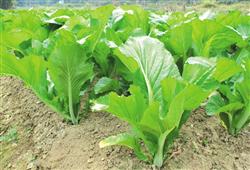
How to plant large mustard greens in winter? Please give an introduction
Large mustard greens, also known as wrapped-heart mustard greens and fleshy mustard greens, belong to the cruciferous family and are a long-day crop. They prefer cool and moist climate conditions, but are not tolerant of frost. Their flesh is thick and tender, fresh and sweet, and they can be stir-fried with meat. They are especially suitable for processing, such as pickling into sour mustard greens. The product has a unique taste and excellent color and flavor, and can be served both as a flavorful side dish on the table and as an excellent accompanying ingredient for boiling, stir-frying, and braising.
1. Cultivation season.
The suitable growth temperature for large mustard greens in winter is 15-25°C. When using the seedling-raising and transplanting method, sowing should generally be done from the end of the first ten days of October to the end of October (the seedling bed period is about 20 days). Usually, after the late rice harvest, transplanting is done in mid-November (before Minor Snow), and harvesting is done from the end of January to the first ten days of February of the following year. The field growth period is 75-85 days, and the general yield per mu is 4000-5000 kg.
2. Garden site selection and planning.
Choose neutral loam farmland with convenient drainage and irrigation and good water quality for planting. Build deep furrows and high beds, preferably with an east-west orientation, with a bed width of 1.2-1.25 m including the furrow. When preparing the land and making beds, apply 1500-2000 kg of decomposed organic fertilizer per mu and 40-50 kg of N, P, K compound fertilizer as base fertilizer.
3. Sowing and seedling raising.
To improve land utilization, seedling raising and transplanting are generally used. The seedling bed should first be covered with decomposed pond mud (or fertile ditch soil) and dried in the air. Each mu requires 3 sq m of seedling bed and 5 g of seed. First use the hand to make holes at 2500-2600 fingers, with each small hole measuring 3 cm x 3 cm, sow 1 seed per hole, and after sowing cover the seeds with a thin layer of soil.
4. Transplanting and field planting.
Plant in double rows, with a row spacing of 60 cm and a plant spacing of 41.6-43.3 cm, planting about 2100-2200 plants per mu. Use the seedling-raising and transplanting method, transplant with soil, and remove stagnant stiff seedlings, weak seedlings, and diseased seedlings. One week after field planting, drench the seedlings with a 0.5% urea (or compound fertilizer) aqueous solution every 3 days for 2-3 times. To improve the survival rate and accelerate greening and early growth, after planting the seedlings, "802" or "Runshengbao" can be used to drench the seedlings, and timely check for missing seedlings and fill gaps to strive for full stands.
5. Soil, fertilizer, and water management.
After transplanting, cover the gaps between seedlings with rice straw to keep the soil moist. For fertilization, attention should be paid to doing a good job with relay fertilizer. Within the first 30 days, apply compound fertilizer once a week, 15 kg per mu; after 30 days, apply once every 10 days. The whole period requires 100-125 kg of compound fertilizer. Under normal climate conditions, water should be supplied by shallow irrigation through the furrows 7-8 times.
6. Pest and disease control.
In the early stage, focus mainly on insect control. The more common ones include leaf miners, cabbage caterpillars, aphids, and planthoppers. In the later stage (after the early heading stage), focus on disease prevention, mainly downy mildew, viral disease, and clubroot. After budding, to prevent disease occurrence, spray "Suidumei" or "Jinggangmycin" once every 5-7 days.
7. Precautions.
(1) Prevent waterlogging, and drain water promptly on rainy days; (2) when strong northerly winds blow, irrigate shallow water and spray water on the leaves; (3) strengthen prevention of disease occurrence under high temperature and high humidity.
Click to get more mustard greens planting techniques
Click to get more vegetable planting techniques