How to treat southern corn leaf blight? Mastering the control methods is key
How to treat southern corn leaf blight? For guidance on southern corn leaf blight, you can refer to the following control methods: 1. Symptom presentation. Southern corn leaf blight can occur throughout the entire growth period of corn, mainly damaging leaves and leaf sheaths, and the husks and ears can also be affected. It usually starts on the lower leaves of the plant and spreads and expands upward. Leaf lesions...
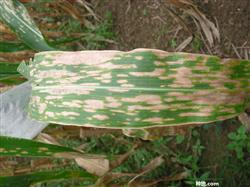
How to treat southern corn leaf blight? Please advise
For southern corn leaf blight, you can refer to the following control methods:
I. Symptom presentation. Southern corn leaf blight can occur throughout the entire growth period of corn, mainly damaging leaves and leaf sheaths, and the husks and ears can also be affected. It usually starts on the lower leaves of the plant first and spreads and expands upward. The shape of leaf lesions varies with variety resistance and has three types: (1) Irregular oval lesions, or nearly rectangular when restricted by leaf veins, with relatively obvious purplish-brown or dark brown edges. This is the most common susceptible lesion type. (2) Oval or spindle-shaped lesions, whose expansion is not restricted by leaf veins, with larger lesions, grayish-brown or yellowish-brown, without obvious dark edges, and sometimes with concentric rings on the lesions. This also belongs to the susceptible lesion type. (3) Small yellowish-brown necrotic spots that basically do not expand, surrounded by an obvious yellow-green halo; these are resistant lesions.
II. Conditions for spread and epidemic. The pathogen is spread by airflow and rainwater. Generally, lesions can appear at the 2-3 leaf stage of summer corn, and at the 5-6 leaf stage the lesions become dense and the leaves scorch. The incubation period of the disease is short, there are many reinfections during the growing season, and the damage is severe. After corn harvest, it overwinters with diseased residues. The key climatic conditions for the occurrence of the pathogen are temperature and humidity. On the basis of a certain amount of inoculum and susceptible varieties, the degree of disease occurrence depends on temperature and humidity. For southern leaf blight, if the temperature in July-August remains stable above 25°C for a relatively long period and there is frequent rain and dew, the disease is severe. In addition, continuous corn cropping leads to severe disease, areas near villages have severe disease, and straw return to the field leads to severe disease.
III. Control methods. Because corn planting area is large, and leaf spot diseases have a wide occurrence range and a concentrated onset period, once an epidemic occurs, it is relatively difficult to control with small localized measures. Therefore, emphasis should be placed on large-scale preventive measures.
1. Remove diseased leaves. In the early stage of the disease, when the incidence rate on the two lower leaves is about 20%, diseased leaves should be removed immediately. The removed diseased leaves should be taken out of the field and deeply buried or burned. After 7-10 days, remove another 3-5 leaves. This has an obvious effect on controlling the spread of the disease. However, it must be carried out over a large area, and completing it within a short period gives obvious results. Immediately after removing diseased leaves, fertilize and water to promote growth and enhance disease resistance.
2. Intertillage and hoeing. Reduce soil moisture and improve field environmental conditions.
3. Increase the application of phosphorus and potassium fertilizers, strengthen field management, and enhance plant disease resistance.
4. Chemical control. In the early stage of the disease, spray 70% thiophanate-methyl wettable powder at 600 times dilution, or 25% benomyl emulsifiable concentrate at 800 times dilution, or 10% difenoconazole water-dispersible granules at 2500-3000 times dilution, or 50% carbendazim wettable powder at 600 times dilution, once every 7-10 days, for 2-3 consecutive applications.
Click to get more corn planting techniques
Click to get more grain crop planting techniques