How to grow mustard greens? A detailed guide to common growing methods
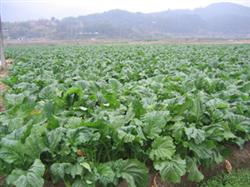
How are organic stem mustard greens cultivated? Please introduce the methods. For the cultivation of organic stem mustard greens, you can refer to the following methods: 1. Sowing and raising seedlings. ① Selecting the seedbed. Choose soil that is deep, loose, rich in organic matter, facing the sun, and convenient for drainage and irrigation. Avoid vegetable plots where cruciferous crops such as Chinese cabbage, cabbage, and ercai have been grown...
 What methods are there for growing mustard greens? Please give detailed methods.
Mustard greens can be grown using the following methods:
1. Soil selection and land preparation
The previous crop on land used for cultivating root mustard greens should generally be cucurbits, legumes, or solanaceous crops, and it is best not to continue cropping with cruciferous crops or land where mustard greens were grown that same year. Grain-vegetable rotation with grain fields and rice can also be used. Choosing loam or clay loam with deep soil and rich organic matter to grow root mustard greens can achieve high yields. After the previous crop is harvested, generally apply 2.25-30,000 kg of farmyard manure or compost, and at the same time add 300-375 kg of superphosphate, 120-150 kg of potassium sulfate, or 750 kg of plant ash as base fertilizer. The amount of base fertilizer applied per hectare should be more or less depending on the soil fertility. Mix the base fertilizer into the soil by plowing and blend it thoroughly with the soil. The plowing depth should reach 25-30 cm. After leveling the land, make high beds 1.2 m wide including ditches. On mountainous land and land with good drainage, low-bed cultivation can be used.
2. Sowing and seedling raising
Root mustard greens can be transplanted after raising seedlings, or directly sown. Directly sown root mustard greens have very few deformed roots, are relatively uniform in shape, have higher yields, and have good processing quality. For convenient management and full use of the land, many places use seedling raising and transplanting to grow root mustard greens.
1. Direct sowing
(1) Suitable sowing time: The sowing period for root mustard greens is relatively strict. Sowing too early easily causes premature bolting, while sowing too late greatly affects yield and quality because early vegetative growth is insufficient, so sowing must be done at the right time. However, the sowing period in each place should be determined according to the local climate. In the southern subtropical region, sowing is mostly done from late August to late September. In mountainous areas and places with poor water sources, sowing can be appropriately earlier, while in fields with convenient irrigation and higher soil moisture, sowing can be appropriately later.
(2) Sowing method: Direct sowing of root mustard greens mostly uses the method of opening holes and spot sowing. The depth of the holes is generally 2-3 cm. After sowing, cover with fine soil or fine residue fertilizer mixed with plant ash. If the field is moist at sowing, irrigation is not needed; if the soil is dry, water thoroughly after sowing before covering. When sowing, sow 5-6 seeds per hole. During sowing, the seeds should be scattered in the hole, not sown in a clump. The sowing rate per hectare is about 1.5-1.8 kg.
(3) Sowing density
The fleshy root of root mustard greens is the raw material for processing pickled and sauced vegetables. If sowing is too dense, the fleshy roots are somewhat small and do not meet processing standards; if sowing is too sparse, the fleshy roots meet processing standards but the ideal yield cannot be reached. Therefore, the sowing density should be determined according to the plant size and spread of each mustard green variety. Generally, for varieties with smaller plants and limited spread, the plant and row spacing is 40 x 50 cm, with 45,000-50,000 plants per hectare; for varieties with tall plants and large spread, the plant and row spacing is 50 x 55 cm, with about 37,500 plants per hectare. At the same time, spacing should be appropriately increased or reduced according to local soil fertility and light conditions. Areas with poor soil fertility and little light should be planted more sparsely, while areas with good soil fertility and good light can be appropriately planted more densely.
2. Seedling raising and transplanting
In many areas, root mustard greens are cultivated by raising seedlings and transplanting. It is also possible to pull seedlings from a directly sown field and transplant them into other fields. The seedling raising method is the same as for other mustard greens. However, the sowing period for raising seedlings should be about 10 days earlier than for direct sowing. In the southwest and southern subtropical regions, the seedling sowing time generally starts in late August after the Start of Autumn and ends in mid-September, and the seedling period is about 40 days. When raising seedlings, pay attention to appropriate thin sowing and thinning so that the spacing between each seedling is about 7 cm, maintaining a certain nutritional area for each seedling, so that strong seedlings can be cultivated for transplanting. The transplanting period is preferably from late September to mid-October. When transplanting, open holes according to the plant and row spacing of the variety and transplant. Plant one strong seedling per hole, requiring the taproot to be vertical in the center of the hole, then fill with fine soil. After transplanting, be sure to water thoroughly to settle the roots. If there is no soaking rain before the seedlings recover, water 1-2 times until all have survived.
3. Field management
(1) Thinning and replanting
After sowing root mustard greens, seedlings generally emerge uniformly in 3-5 days. About 20 days after emergence, when two leaves and one heart can be seen, thinning should be carried out. For direct sowing, keep 3 strong seedlings per hole and maintain a certain distance between them. After another 10-15 days, final thinning should be carried out, keeping only 1 intact and strong seedling per hole. When final thinning, pay attention to the characteristics of the variety, remove impurities and inferior plants, and keep the true ones, and use the strong seedlings pulled out during thinning to replant missing holes. Seedlings used for replanting must be replanted with soil, without damaging the roots, to ensure they survive in one replanting. For seedling-raised and transplanted plants, thinning should be carried out 1-2 times when the seedlings in the seedbed are about 20 days old, removing seedlings in overly dense places and keeping the seedlings in the seedbed uniform and strong. Before transplanting, water the seedbed thoroughly first, then lift the seedlings with soil and transplant them into the field at a certain plant and row spacing.
2. Topdressing, irrigation, intertillage, and weeding
For direct sowing, when the seedlings have two leaves and one heart, carry out intertillage and weeding at the same time as thinning, and then apply the first fertilizer. This topdressing is mainly to promote seedling growth and should be applied lightly. Per hectare, use 15,000 kg of clear farmyard manure water mixed with 45-60 kg of urea, and mix in clear water when applying. After final thinning, carry out the second intertillage and weeding and apply the second topdressing. This topdressing is to lay the nutritional foundation for the next expansion of the fleshy root, so it can be applied somewhat more concentratedly. Per hectare, use 22,500 kg of farmyard manure water, mixed with 60-25 kg of urea and 75-90 kg of potassium sulfate, and apply together. About 15 days after final thinning, carry out the third intertillage and weeding, followed by the third topdressing. Per hectare, use 22,500 kg of farmyard manure water, mixed with 75-90 kg of urea and 90-120 kg of potassium sulfate. At this time the rainy season has ended, so irrigation should be combined with fertilization. Afterward, apply topdressing another 2-3 times according to seedling conditions, especially during the fleshy root expansion period, where heavy topdressing should be applied. The fertilization principle throughout the growing period is light first and heavy later, thin first and concentrated later. Irrigation should be done with small amounts and frequent watering, and flooding irrigation must be strictly avoided. Irrigation must also be based on weather and soil drought conditions. Intertillage and weeding are generally carried out 3-4 times. The first is shallow intertillage, the second can be deep intertillage of 10-15 cm, the third is shallow intertillage, and the fourth should be light intertillage according to seedling conditions, removing weeds.
(3) Pinching out the heart
In the main production areas for growing mustard greens, from late October to December, premature bolting is often found, and the reason is not yet fully understood. If this phenomenon occurs, the bolt can be removed at any time. After removal, the fleshy root of root mustard greens can still expand, but it should be removed as early as possible. Therefore, during the period from October to December, the field should be checked frequently, and whenever one plant is found, its bolt should be removed, which helps the fleshy roots of root mustard greens expand uniformly.
(4) Pest and disease control
The main insect pests of root mustard greens are cabbage caterpillars and aphids, and the main disease is viral disease. These pests and diseases are common pests and diseases of cruciferous vegetables, so simply refer to the pest and disease control methods for cruciferous crops.
3. Harvesting
For root mustard greens, from sowing to harvest of the fleshy root depends on the variety and local climate conditions. Generally, harvest when the fleshy root has fully expanded and before the flower stalk is about to appear. The signs of maturity are: the basal leaves have withered and yellowed, and the root head has changed from green to yellow. When harvesting, use a hoe to dig up the root mustard greens, then use a sharp knife to remove the stems, leaves, and lateral roots, and they can be transported to the market or processing plant for sale.
Click to get more mustard green growing techniques
Click to get more vegetable growing techniques