How do you carry out the planting and management of leaf-type pumpkin?
How do you plant and manage "leaf-type" pumpkin? Please give an introduction. For planting leaf-type pumpkin, you can refer to the following methods for planting and management: 1. Choose the sowing time. Pumpkin is a vegetable that likes warmth and tolerates heat, and the optimum temperature for stem and vine growth is 18-22°C. Therefore, "leaf-type" pumpkin can be sown from late February to early April...
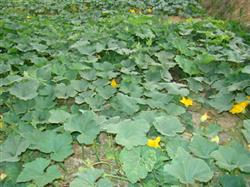
How do you plant and manage "leaf-type" pumpkin? Please give an introduction.
For planting leaf-type pumpkin, you can refer to the following methods for planting and management:
1. Choose the sowing time.
Pumpkin is a vegetable that likes warmth and tolerates heat, and the optimum temperature for stem and vine growth is 18-22°C. Therefore, "leaf-type" pumpkin can be sown from late February to early April.
2. Field selection and land preparation.
In order to cultivate robust stems and vines, prevent pumpkin from flowering early, and increase the leaf-picking time, "leaf-type" pumpkin should preferably be planted on loam or sandy loam with high organic matter content and strong sustained fertilizer supply capacity. Plant on raised beds, with a bed width of 2.5 m, a ditch width of 40 cm, and a ditch depth of 40-50 cm.
3. Reasonable close planting.
Pumpkin is generally planted by raising seedlings and transplanting, and should be transplanted in time when there are about 3 leaves. "Leaf-type" pumpkin should use creeping cultivation, with appropriately close planting, using double-row planting, with a plant spacing of 50 cm, and about 800-1000 plants per mu is suitable.
4. Field management.
1. Reasonable vine guiding and vine trimming. During the growth of pumpkin, vines should be guided frequently so that the stems and vines are reasonably distributed, ventilation and light transmission are improved, and pests and diseases are reduced. For "leaf-type" pumpkin, pinch and trim the vines at 7-8 leaves, and carry out a second pinching and vine trimming at about 12 leaves, so as to increase the number of stems, vines, and leaves and raise leaf yield.
2. Reasonable topdressing. "Leaf-type" pumpkin is mainly harvested for its vegetative body. Therefore, nitrogen fertilizer should be appropriately increased to prolong the vegetative growth period, thereby extending the harvest time. (1) Apply light seedling-promoting fertilizer: 5 days after transplanting, apply 20-25 loads of decomposed manure water per mu, or apply 4-5 kg of urea mixed with 1000 kg of water for drenching, to promote early and rapid growth of young seedlings. Weak seedlings should be given more fertilizer to promote balanced growth across the whole field. (2) Apply heavy vine-forcing fertilizer: 10-12 days after transplanting, apply 500 kg of decomposed farmyard manure + 20 kg of urea per mu. After entering the picking period, drench once every 7 days with 1000 kg of 20-30% manure and urine water per mu, or apply 5-7 kg of urea mixed with 1000 kg of water for drenching.
3. Water management. When pumpkin encounters drought and fertilizer deficiency, it is prone to early flowering and early fruiting, and the leaves turn yellow and become smaller. Therefore, the field for "leaf-type" pumpkin should be kept moist to promote the growth of pumpkin plant stems and leaves and prevent premature aging of stems and leaves.
4. Pest and disease control. (1) Control of main diseases: for downy mildew, spray 58% Ridomil 600-fold solution, 75% chlorothalonil 800-fold solution, or 70% thiophanate-methyl 800-fold solution for control; for powdery mildew, spray 20% triadimefon 2000-fold solution or 75% chlorothalonil 700-fold solution for control; for phytophthora blight, spray 72% Curzate 800-fold solution or 70% mancozeb 800-fold solution for control. (2) Control of main insect pests: for whitefly, spray 40% dimethoate emulsifiable concentrate 1000-fold solution or 25% buprofezin wettable powder 1500-fold solution for control; for mites, spray 73% propargite 2000-fold solution or 20% dicofol 1000-fold solution.
5. Timely harvesting.
The harvesting of pumpkin leaves (including leaf stalks) should follow the principle of picking less in the early stage, more in the middle stage, and less in the late stage. They can be picked when the leaf color becomes lighter and the leaves are thick and substantial. After picking, an appropriate amount of leaves should be retained to ensure the needs of plant growth. In the late picking stage, that is, after flowering, the entire inflorescence can be picked and sold together with the leaves.
Click to get more pumpkin planting techniques
Click to get more vegetable planting techniques