How to Grow Ornamental Squash? Detailed Guide to Planting Methods and Techniques
How to grow ornamental squash? Here is an introduction to the planting methods. To grow ornamental squash, you can refer to the following methods: 1. Ornamental characteristics of common varieties (1) Dragon-Phoenix Ladle: a small spoon-shaped fruit, with a spherical lower part and a graspable long handle on top. The bottom of the fruit is dark green, the upper part is orange-yellow, and both have pale yellow alternating stripes...
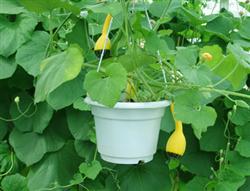
How to grow ornamental squash? Here is an introduction to the planting methods
To grow ornamental squash, you can refer to the following methods:
1. Ornamental characteristics of common varieties
(1) Dragon-Phoenix Ladle: a small spoon-shaped fruit, with a spherical lower part and a graspable long handle on top. The bottom of the fruit is dark green, the upper part is orange-yellow, and both have pale yellow alternating stripes.
(2) Mandarin Duck Pear: a small pear-shaped fruit, with a dark green bottom, a golden-yellow upper part, and pale yellow alternating stripes throughout.
(3) Dabing Dan: a large fruit, traditionally shaped like the figure "8", with round spheres at the top and bottom and a thinner connecting part.
2. Key points of cultivation techniques
(1) Sowing period. In South China, open-field cultivation is divided into spring and autumn seasons. Spring sowing is generally from January to February, and autumn sowing is generally from July to August. Greenhouses allow year-round cultivation.
(2) Seedbed selection and seedling soil preparation. Raising seedlings in a greenhouse in early spring can protect against cold and preserve warmth; in autumn, cover with a shade net when raising seedlings to prevent rain and lower temperature. Insect-proof nets should be used around the greenhouse to prevent pests and diseases. Mix 6 parts peat soil + 3 parts river sand + 1 part perlite, add 1 kg of compound fertilizer (nitrogen 15 : phosphorus 15 : potassium 15) per cubic meter to make nutrient soil, and use plastic seedling cups measuring 8 cm x 8 cm for raising seedlings.
(3) Cultivating strong seedlings. Before sowing, wrap the seeds in a towel and soak them in 30°C warm water for 3-4 hours, then place them in a 30°C constant-temperature chamber for germination, and sow after the radicle emerges. The day before sowing, water the seedling soil thoroughly, sow 1 seed per cup, then cover with 0.8-1 cm of nutrient soil, cover with a shade net and water thoroughly, and remove the shade net promptly after the cotyledons emerge. During seedling raising, pay attention to maintaining suitable temperature and soil moisture. Generally, the temperature inside the greenhouse in early spring should be around 25°C, and the seedling soil should not be too wet or too dry to avoid disease. Spray with 500x Dexon solution or 800x carbendazim solution to prevent damping-off. If the seedlings grow weakly or the leaves turn yellow during the seedling stage, spray 1-2 times with 2% compound fertilizer solution. Transplant when the seedlings have 4-5 true leaves.
(4) Transplanting. Apply 1000 kg of decomposed chicken manure and 30 kg of compound fertilizer per mu (1 mu = 667 sq m, the same below) as base fertilizer. The transplanting field surface should be level. Ten days before transplanting, seal the greenhouse film tightly and use high-temperature closed treatment to sterilize and kill insects. Squash is a vining plant, and ornamental squash mostly uses trellis cultivation, so the density should not be too high, generally about 1200 plants per mu. Transplant on a clear evening. Spray thoroughly with water half a day before transplanting. Remove the plastic seedling cups during transplanting, taking care to keep the seedling soil intact and avoid damaging the roots. After transplanting, spray enough water to settle the roots. In summer, cover the top of the greenhouse with a shade net to prevent the young seedlings from being killed by the scorching sun.
(5) Field management
1) Water. After transplanting, special attention should be paid to water management for the new seedlings. Spray water in the morning and evening to keep them moist. Ornamental squash needs less water in the early growth stage. After the seedlings recover, spray water once a day to keep the soil moist. If the weather is humid, spray water once every two days. During the vigorous growth stage and the flowering and fruiting stage, water demand is higher, so the water supply must be ensured. In summer, when the sun is strong and the air is dry, spray water 2-3 times a day.
2) Temperature management. Ornamental squash is a warmth-loving crop, with a suitable growth temperature of around 25°C. The temperature inside the greenhouse should be controlled at 15°C-30°C. When it is below 15°C, cover the greenhouse film to preserve warmth and avoid cold damage. When the temperature is above 30°C, uncover the greenhouse film to strengthen ventilation and add a shade net on top of the greenhouse to cool it down.
3) Fertilizer management. Seven days after transplanting, spray the roots with a 3% compound fertilizer aqueous solution. Before new roots sprout, vines are drawn, and flowering begins, spray once a week with 3% compound fertilizer water to make the plants grow robustly. During the period from flowering to fruit development, control water and fertilizer. Generally, after setting 2-3 fruits, apply 50 kg of organic fertilizer and 20 kg of compound fertilizer per mu as a topdressing to promote the expansion of young fruits. The method is hole application or strip application at a distance of 25 cm from the base of the stem. Be careful not to apply too close to the stem base, otherwise it may easily cause root burn. Spray water after application. During the peak fruiting period and harvest period, apply fertilizer once more according to the fruit-setting condition of the plants and changes in leaf color, using the same method as above. In addition, spray with 1000-1200x Plant Power Liquid 2000 to increase the fruit-setting rate.
4) Vine training and pruning. When the seedlings are 25-30 cm tall, use bamboo poles or hanging ropes to guide them upward. Squash has many side vines during growth, but ornamental squash mainly relies on the main vine, so all side vines below 1 m on the plant should be removed promptly to avoid consuming nutrients and affecting flowering and fruiting. After the main vine reaches the trellis, 1-2 side vines may be retained to increase the number of fruits. Side branches that affect plant shape should be pruned to keep the plant compact and ornamental.
5) Artificial pollination. Begin pollination at 9:30 in the morning. Select male flowers that open on the same day, remove the corolla, and spread the pollen from the stamens onto the stigma of the female flower. If pollination is too early, the pollen has not dispersed; if too late, the pollen loses viability. Both will affect the fruit-setting rate.
6) Pest and disease control. Ornamental squash is susceptible to powdery mildew, viral disease, and fusarium wilt, and is prone to damage by aphids and mites. Use 800x Bingwei + 800x carbendazim solution or 600x triadimefon solution to prevent powdery mildew; use 40% dimethoate emulsifiable concentrate at 800-1000x solution or Thrips-Aphid Clear at 1000x solution for spraying to control aphids; use 800x Kangman 23 to control mites; use 20% Virus A at 500x solution to prevent viral disease. When spraying, spray evenly on both the front and back sides of the leaves to improve control effectiveness.
7) Harvest. Ornamental squash is mainly used for ornament or as an art piece, so it is generally harvested after the fruit is fully mature and the rind has hardened. If used for food, it can be harvested about 20 days after flowering, before the rind hardens, and can be picked with scissors along with the stem.
Click to get more squash cultivation techniques
Click to get more vegetable cultivation techniques