How to control rice stem borers? Practical methods and techniques explained
How to control rice stem borers? Please advise. Rice stem borers are commonly known as dead-heart borers, among which the most widespread and serious are the striped stem borer and the yellow stem borer, along with the rice skipper and the greater rice stem borer. The striped stem borer damages not only rice but also gramineous crops such as corn and wheat, while the yellow stem borer is a monophagous pest that attacks only rice. For...
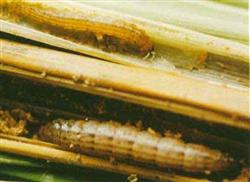
How to control rice stem borers? Please advise
Rice stem borers are commonly known as dead-heart borers, among which the most widespread and serious are the striped stem borer and the yellow stem borer, along with the rice skipper and the greater rice stem borer. The striped stem borer damages not only rice but also gramineous crops such as corn and wheat, while the yellow stem borer is a monophagous pest that attacks only rice.
Damage characteristics
A stem borer goes through 4 stages in its life: adult, egg, larva and pupa, and only the larval stage bores into and feeds on rice stems. The striped stem borer larva is light brown with 5 purplish-brown longitudinal lines on its back; the yellow stem borer larva is yellowish-white or pale yellow with a green longitudinal line down the center of its back.
The yellow stem borer bores into rice stems as a larva. At the seedling and tillering stages it bores into stems to form dead-heart seedlings, or bores into leaf sheaths, causing yellow-brown streaks at the damaged spots and forming "dead sheaths." If it bores into stems at the booting stage, it forms dead panicles; if it bores into stems after heading, damage to the panicle neck node forms "white heads," reducing yield; it also forms "insect-damaged plants," which cause relatively lighter losses.
The borer moth hides by day among rice clumps or grasses and is active at night, with phototaxis and a habit of laying eggs on tender green rice plants. It lays more eggs during the tillering and booting stages of rice. Newly hatched larvae first gather inside leaf sheaths to cause damage, forming dead sheaths, and later bore into stems to form dead hearts, etc. Mature larvae pupate inside rice stems.
Control methods
1. To control rice stem borers, adopt selective control of the first generation of the striped stem borer and heavy control of the second generation; for the yellow stem borer, focus on heavy control of the third generation.
2. Before the peak hatching and pupation of stem borers, keep only muddy water in the field to lower the parts where young larvae cause damage or pupate. After the peak of hatching or pupation, flood deeply with 13-16 cm of water, which can kill large numbers of stem borers.
3. Chemical control:
For the rice leaf roller, control should be timed at the peak of egg hatching. For light outbreaks, use 50 ml of 1.8% abamectin or 45 ml of 2.0% abamectin per mu, diluted in 15-30 kg of water (increase water volume as appropriate according to rice growth conditions and pest situation), and spray once more after an interval of 15 days; for severe outbreaks (severe overlapping generations), use 75-100 ml of 1.8% abamectin or 70-100 ml of 2.0% abamectin per mu as a single application, and spray once more after an interval of 10 days.
For the rice striped stem borer and yellow stem borer, vigorous control of the first generation must be carried out, which can both protect seedlings and reduce the population density of the next generation. According to the characteristics of the pesticides, apply chemicals within 3 days from the hatching of young larvae to the peak of hatching to control dead sheaths; in all types of rice fields, apply chemicals from the beginning of the hatching peak to the peak of hatching to control insect-damaged plants, dead booting panicles and white heads. Selected pesticides: to prevent dead hearts at the seedling stage, use Pinyan (1.8% abamectin EC 50 ml + 40% isocarbophos EC 50 ml) or Duiduiqing (2% abamectin EC 50 ml + 40% isocarbophos EC 50 ml) diluted in 30 kg of water for spraying; to prevent white heads at the rice heading stage, use Zheyan (1.8% abamectin EC 75-100 ml + 40% isocarbophos EC 75-100 ml) or Duiduiqing (2% abamectin EC 75-100 ml + 40% isocarbophos EC 75-100 ml), diluted in 30 kg of water for spraying; to prevent insect-damaged plants at the rice dough stage: use Zheyan (1.8% abamectin EC 100 ml + 40% isocarbophos EC 100 ml) or Duiduiqing (2% abamectin EC 100 ml + 40% isocarbophos EC 100 ml), diluted in 30-45 kg of water for spraying.
Click to get a massive amount of rice cultivation techniques
Click to get a massive amount of grain cultivation techniques