What precautions should be taken for foliar fertilization of rice?
What should be noted in foliar fertilization of rice? Please advise. Foliar fertilization has the advantages of low dosage, strong targeting, fast absorption, obvious effect and low cost. At present, rice is in its vegetative growth stage. How can the rapid growth of rice roots, stems, leaves and tillers be promoted? The author reminds farmers that when carrying out foliar fertilization on rice, they should...
What should be noted in foliar fertilization of rice? Please advise
Foliar fertilization has the advantages of low dosage, strong targeting, fast absorption, obvious effect and low cost. At present, rice is in its vegetative growth stage. How can the rapid growth of rice roots, stems, leaves and tillers be promoted? The author reminds farmers that when carrying out foliar fertilization on rice, they should pay attention to the following six aspects:
Be targeted Select the corresponding foliar fertilizer according to the fertilizer requirements of rice at each growth stage, and supplement in a targeted way. For example, at the new bud stage, nitrogen fertilizer should be the main type, and at the same time, combining it with potassium fertilizer gives a notable effect; at the seedling stage, potassium fertilizer should be increased to cultivate strong seedlings; at the booting and flowering stage, phosphorus fertilizer needs to be supplemented to make the grains plump.
The concentration must be appropriate When applying foliar topdressing to rice, the concentration must be well controlled. During use, strictly follow the relevant instructions. Generally, a 500-800 times dilution is suitable. It is strictly forbidden to increase the concentration at will, to prevent fertilizer burn or toxicity. This is especially true for trace element fertilizers, as the critical range for rice from deficiency to excess is very narrow, so the concentration must be controlled even more strictly.
The time must be suitable Foliar topdressing is best done in the morning or evening on a clear day, under windless conditions.
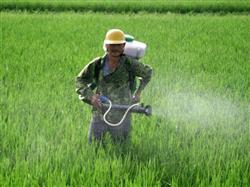
The method must be careful Rice is a monocot plant, and its leaf area is relatively small. The intercellular spaces on the underside of the leaf are large, and there are more pore cells, so it absorbs the fertilizer solution more easily than the upper surface of the leaf. Therefore, when spraying, strive to make both the front and back sides of the leaves evenly covered with the solution. Of course, the spraying amount should not be too large. It is best if the rice leaves are not dripping, and generally 50-60 kg of fertilizer solution is sprayed per mu.
The number of applications must be reasonable The concentration of foliar topdressing for rice is relatively low, and the amount absorbed each time is relatively small, so the number of foliar topdressing applications should be no less than 2-3 times.
Mixing pesticide and fertilizer for spraying must be done properly Before mixing pesticide and fertilizer for spraying, first clarify the properties of the pesticide. If the two have opposite properties, they must never be mixed for spraying. When preparing the mixed solution, be sure to stir evenly and use it immediately after preparation. Generally, first prepare the fertilizer into an aqueous solution, then directly add the pesticide according to the dosage into the prepared fertilizer solution, shake well and then spray.
Click to get a large amount of rice cultivation techniques
Click to get a large amount of grain cultivation techniques