How can you grow black-skinned winter melon (wax gourd) for high yields?
How can you grow black-skinned winter melon for high yields? Is there a detailed growing method? To achieve high yields when growing black-skinned winter melon, you can refer to the following methods: 1. Sowing and raising seedlings. 1. Seed treatment. Because winter melon seeds have a relatively thick seed coat and do not absorb water easily, they should be soaked to promote germination and disinfected before sowing. Soak the seeds in a 250-fold dilution of 50% carbendazim for 20 minutes. After disinfection, wash the seeds with clean water, then soak them for 5-6 hours, remove them and promote germination. The germination temperature should be about 30°C.
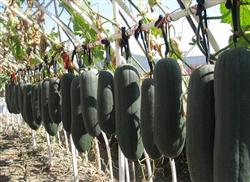
How can you grow black-skinned winter melon for high yields? Is there a detailed growing method?
To achieve high yields when growing black-skinned winter melon, you can refer to the following methods:
I. Sowing and raising seedlings
1. Seed treatment. Because winter melon seeds have a relatively thick seed coat and do not absorb water easily, they should be soaked to promote germination and disinfected before sowing. Soak the seeds in a 250-fold dilution of 50% carbendazim for 20 minutes. After disinfection, wash the seeds with clean water, then soak them for 5-6 hours, remove them and promote germination. The germination temperature should be about 30°C.
2. Raising seedlings. Sow early at the right time, from the end of January to the beginning of February. After sowing, cover with a plastic arched tunnel to protect against cold. When the seedlings grow one true leaf and one heart leaf, transplant them into nutrition bags. The nutrition bag size is 15 x 18 cm. Use fertile soil that has not previously grown cucurbit crops as the nutrition soil. After planting, cover again with a plastic arched tunnel to protect against cold.
II. Field planting
1. Site selection. Choose new land that has not previously grown cucurbit crops, or fields that have undergone 3-5 years of paddy-upland rotation, for planting.
2. Making beds and preparing the land. Make the bed surface 110-120 cm wide, with ditches 50 cm wide. Surround the field with a ring ditch so that all ditches connect, making irrigation and drainage convenient.
3. Reasonable close planting. When the temperature is stable above 15°C, choose a sunny day for transplanting, and remove the nutrition bags when planting. Plant one row per bed, with a plant spacing of 60-70 cm. Plant 450-550 plants per mu, and water with settling water after planting.
III. Fertilizer and water management
1. Apply sufficient base fertilizer. When making beds and preparing the land, open a long ditch in the middle of the bed and bury the base fertilizer. Apply 2000-3000 kg of organic fertilizer and 50 kg of superphosphate per mu.
2. Apply seedling fertilizer skillfully. When the seedlings grow 5-6 true leaves, apply 10-15 kg of three-element compound fertilizer (N, P, K content 15% each) and 8-10 kg of urea per mu. This promotes vine growth and increases the plant's nutrient accumulation. It helps female flower formation and fruit setting. After the first female flower opens, control fertilizer and water to prevent excessive vegetative growth. Protect flowers and fruit setting.
3. Apply heavy fertilizer for fruit development. When the fruit grows to 3-4 kg, strengthen fertilizer and water management. Apply 15-20 kg of three-element compound fertilizer (N, P, K content 15% each), 10-15 kg of urea, and 8-10 kg of potassium chloride per mu. Apply once every 10-15 days, for 4-5 consecutive applications. Winter melon growth requires a lot of water, so irrigate promptly in the morning, irrigate to half the bed height, drain after the whole bed is moistened, and keep the soil moist. Pay attention to draining accumulated water during rainy periods.
IV. Trellising and vine training.
After field planting, when the seedlings are 50-60 cm tall, set up trellises to guide the vines. The trellis height is 60-70 cm. Remove all side vines before fruit setting, and when the fruit weighs 3-4 kg, keep 2-3 side vines.
V. Artificial supplementary pollination.
Winter melon flowers are monoecious with separate male and female flowers. To increase the fruit-setting rate, carry out artificial pollination. The method is to choose a male flower that has just opened in the morning, remove the petals, and gently smear the anther onto the stigma of the female flower.
VI. Selecting and keeping young fruits.
The size of the winter melon is related to the node position where the fruit sets and the quality of the young fruit. When keeping fruits, select them on the thick-growing internode section of the vine. Generally, on nodes 21-27, select and keep 2-3 young fruits that are consistent in size at the upper and lower parts, fully covered with fine hairs, and glossy. After fruit setting, when the diameter reaches 10 cm, remove the reserve fruits, keeping one fruit per vine.
VII. Pest and disease control.
1. Disease control. The main diseases of winter melon are Fusarium wilt and Phytophthora blight. For control, adopt a strategy combining cultivation control and chemical control. For cultivation control, use 3-4 years of paddy-upland rotation with non-cucurbit crops, apply more organic fertilizer, appropriately control chemical nitrogen fertilizer, and apply more phosphorus and potassium fertilizer. Chemical control. In the early stage of Fusarium wilt, drench the roots with an 800-fold dilution of Guakuning, or a 200-fold dilution of Nongkang 120, or a 600-fold dilution of 70% Dexon. For Phytophthora blight, pay attention to control after heavy rain or rainstorms, and spray with a 600-fold dilution of 58% Ridomil or 72% Keyishuang, or an 800-fold dilution of 12% copper abietate.
2. Pest control. The main pests of winter melon include stink bugs, melon thrips, and melon leaf borers. For control, choose high-efficiency, low-toxicity pesticides and use them in rotation. For stink bugs, spray with a 600-fold dilution of 90% trichlorfon or 80% dichlorvos. For melon thrips, pay attention to control before fruit setting, and spray with a 2000-fold dilution of 25% pymetrozine or a 1000-fold dilution of Haoniandong. For melon leaf borers, spray with a 1500-fold dilution of Chongmanshaxing or Aifuding No. 3, or spray with an 800-fold dilution of phoxim after 4 p.m.
Click to get more winter melon growing techniques
Click to get more vegetable growing techniques