What should be noted when growing winter melon?
What should be noted when growing winter melon? Please provide guidance.
When growing winter melon, note the following key points:
1. Soil selection
For growing winter melon, choose a well-drained, deep, fertile sandy loam or clay loam, with a previous crop field where no cucurbit crops have been grown for more than three years; a previous rice crop is even better.
2. Timely sowing
In the Guangzhou area, winter melon cultivation is divided into spring planting and autumn planting, with spring planting being more common, generally sown in January-February. Under the premise of taking cold-protection measures for winter melon seeds, early sowing is better than late sowing, so in recent years it is mostly sown in early to mid-January, which can extend the growth period, especially the vegetative growth period, so that winter melon sets fruit around the rainy season when air humidity is relatively high and the temperature is above 20°C. Autumn-planted winter melon is generally sown around Minor Heat (early to mid-July).
3. Cultivating strong seedlings
(1) To cultivate disease-free strong seedlings, the seeds must be disinfected and sprouted: soak the winter melon seedlings/seeds in a 500-fold dilution of 50% carbendazim for 1 hour, then wash clean with water, then soak the seeds in 50°C warm water for 3 hours; after washing clean with water until there is no off odor, wrap them well in clean gauze or a thin towel, place at 30°C to sprout, and sow once the seeds show sprouts of 3-5 mm.
(2) To cultivate disease-free strong seedlings, insulated seedling raising in nutrient cups (bags) is mostly used: use nutrient cups (bags) with a diameter of 10 cm x 10 cm or more, and after sowing, raise seedlings with insulation in a small arched shed or greenhouse.
During seedling raising, in addition to keeping the seedbed moist, you can also spray propamocarb aqueous solution and abamectin to prevent damping-off and leafminer pests; when the temperature inside the shed exceeds 30°C, ventilate and cool promptly. Autumn-planted winter melon is mostly directly sown in the field after seed soaking and sprouting.
4. Planting out
Winter melon is raised with insulation in nutrient cups (bags), and the seedling stage can be longer; transplant only when the seedlings have 3-5 true leaves. The planting time is determined according to temperature conditions; in the Guangzhou area it can be planted from late February to early March. After plowing and harrowing the planting site, make beds at 1.7 m (including trenches), with bed height 0.5 m and width 1.2 m; broadcast phosphate fertilizer 50-75 kg over the entire bed surface per mu, and open a deep trench in the center of the bed to bury 1000-1500 kg of decomposed poultry manure. Before planting, apply 1:100 carbendazim mixed with soil in the planting holes to prevent disease; plant in a single row with a spacing of 0.65 m, about 600 plants per mu.
5. Trellising, vine training, and fruit retention
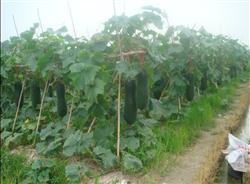
Trellising and vine training are important steps in winter melon cultivation. The trellis form generally uses the three-star drum trellis with dragon-root style. When the vine grows to 60 cm, let the main vine coil on the ground around its own drum trellis, and combine with vine pressing to fix the growth direction. When the vine grows to 18 nodes, it can be guided onto the trellis, and all side vines should be removed before and after fruit setting; after retaining the fruit, keep 10-12 leaves on the main vine and pinch off the top. The node position for retaining winter melon fruit has a certain relationship with fruit size; the fruit-retaining node should be between nodes 23-25, among which the fruit at nodes 25-30 is the largest. To bring it to market earlier, fruit can also be retained at nodes 19-20, but the yield is lower. To increase the fruit-setting rate and reduce "empty vines," it is necessary to carry out manual supplementary pollination and promptly control the melon fruit fly (needle bee) and thrips that affect fruit setting.
6. Fertilizer and water management
Winter melon has a long growth period and high yield, and requires relatively large amounts of fertilizer and water. Before the seedling stage, very little fertilizer and water are needed, and not much is needed during the vine-running stage either, but during flowering and fruiting, especially after fruiting, sufficient fertilizer and water are needed. In terms of topdressing amount, before guiding the vines onto the trellis, apply 30%-40% of the total fertilizer amount, from pollination to fruit hanging apply 60%-70%, and stop fertilizing 20 days before harvest. Generally, during the seedling stage, use light water and light fertilizer to promote seedling growth; from vine running to fruit setting, fertilizer and water should not be too much and should be properly controlled to favor fruit setting. After the fruit is selected, fertilizer and water should be sufficient to promote fruit enlargement; within 15-25 days, continuously apply heavy fertilizer 2-3 times, each time applying 15-25 kg of imported compound fertilizer, together with watering; on sunny days, half a trench of water can be released. Before and after heavy rain, avoid fertilizing and over-applying nitrogen fertilizer, so as to avoid causing diseases.