Control Methods and Technical Key Points for Clubroot of Rapeseed
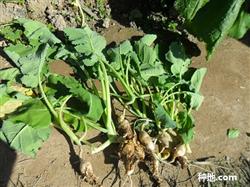
How to control clubroot of rapeseed? Please explain. Clubroot of rapeseed occurs on the roots. The pathogen generally invades through root hairs or young roots, forming galls on the main root or lateral roots. It is commonly known as "big head disease." In the early stage, the surface is smooth and white; later it turns brown, rough and cracked. It is easily infected by other pathogens and rots...
How to control clubroot of rapeseed? Please explain
Clubroot of rapeseed occurs on the roots. The pathogen generally invades through root hairs or young roots, forming galls on the main root or lateral roots. It is commonly known as "big head disease." In the early stage, the surface is smooth and white; later it turns brown, rough and cracked. It is easily infected by other pathogens and rots with a foul smell. Because the upper part of the main root or the stem base decays below, some new roots can grow. When damage is severe at the seedling stage, it can cause young seedlings to die. When the disease occurs at the adult plant stage, the leaves on the lower part of the plant become lighter in color, the plant is short, and the outer leaves wilt at noon but can still recover in the morning and evening. In severe cases, the plant wilts after a few days and cannot recover, and finally the whole plant dies. In mild cases, when fertilizer and water are sufficient, the plant can mature and set seed. However, the plant is slender, branching is reduced, and yield drops sharply.
"There are five causes of clubroot of rapeseed: soil, climate, variety, fertilization and sowing method," said Wang Shuang. Clubroot of rapeseed is a soil-borne disease. Once it occurs, ordinary control and chemicals are unlikely to achieve ideal results, so comprehensive control measures are best used.
According to the introduction, comprehensive control measures should first use disease-resistant varieties. It is recommended that townships with severe incidence choose relatively resistant varieties, such as Xingyou No. 2 and Deyou No. 5, in combination with local varieties. Practice crop rotation. Because dormant spores have strong stress resistance, rapeseed fields with severe incidence should practice crop rotation for 4 to 5 years. Within the prescribed rotation period, do not plant rapeseed or cruciferous vegetables. Fields with mild incidence can rotate with one year of wheat to reduce the occurrence.
Raise seedlings and transplant. Choose a field where cruciferous crops have not been planted for more than 3 years or slightly alkaline soil as the seedbed. Disinfect the seedbed soil with 50% Dexon at 400 times or formalin at 50 times, or with 50% carbendazim at 300 times. Seed treatment. Remove diseased pests and inferior seeds by winnowing, screening and sun-drying, then dress the seeds with Shileshi at 1:500 before sowing.
Strengthen fertilizer and water management. Use potassium-containing compound fertilizer and boron fertilizer as base fertilizer in the seedbed, apply less nitrogen fertilizer and superphosphate, and strengthen ditching and drainage to reduce moisture, cultivating strong seedlings. Transplant after the 5-leaf stage, and remove infected diseased plants when transplanting.
Chemical control at the seedling stage. The true leaf expansion stage of rapeseed is the key period for control. Spray or splash the entire seedbed with 70% chlorothalonil at 600 to 800 times or 70% thiophanate-methyl at 600-800 times. When transplanting, 2% lime water can be used as the rooting water.
Click to get more rapeseed planting techniques
Click to get more grain crop planting techniques