How should colored bell peppers be grown for the best results?
How do you grow colored bell peppers well? Please give guidance. To cultivate colored bell peppers, you can refer to the following methods: (1) Main cropping season arrangements. 1. For year-round cultivation in automatically heated greenhouses and winter-spring season cultivation in northern solar greenhouses, sowing and seedling raising are generally done in mid-August, transplanting in mid-October, and the harvest period can last from mid-January to July.
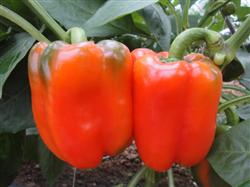
How do you grow colored bell peppers well? Please give guidance.
To cultivate colored bell peppers, you can refer to the following methods:
(1) Main cropping season arrangements
1. For year-round cultivation in automatically heated greenhouses and winter-spring season cultivation in northern solar greenhouses, sowing and seedling raising are generally done in mid-August, transplanting in mid-October, and the harvest period can last from mid-January to July. This cropping season is called the long-cycle cultivation model. It is characterized by a long harvest period, high yield and good economic returns, but correspondingly it also has high requirements for water and fertilizer management and insulation measures.
2. For early spring cultivation in plastic tunnels in the south, sowing and seedling raising are generally done in late October (under conditions with electrically heated seedbeds), and large seedlings are transplanted in early March of the following year, with the harvest period from April to July. If seedling-raising conditions are poor, the sowing date is postponed. For the autumn cropping season, sowing can be done in early July, transplanting in mid-to-late August, with insulation strengthened later, concentrating the crop on the market during New Year's Day to the Spring Festival. This cropping season has a short harvest period, but the market price is high.
3. Because the above models are affected by high summer temperatures, no product can be produced from August to November. However, in high mountain areas at an altitude of about 600 m, sowing and seedling raising in early spring and making use of the lower summer temperatures for over-summer cultivation can make up for this shortcoming.
(2) Sowing and seedling raising
The quality of seedling-raising techniques for colored bell peppers is crucial to obtaining high yields. In principle, during summer seedling raising, attention should be paid to cooling and shading, while in winter attention should be paid to insulation (but humidity must not be too high). The optimal temperature during the seedling stage: 26 degrees during the day and 19 degrees at night. Colored bell peppers emerge slowly and have a long seedling period. Excessive water in the seedbed can easily cause seed rot, so when raising seedlings in summer it is best to first use a soilless substrate for shaded seedling raising, then prick out seedlings into nutrient pots at the 2-leaf-1-heart stage to grow into seedlings, and generally transplant at the 4-5 true-leaf stage.
(3) Transplanting, fertilization and irrigation
1. Under the long-cycle cultivation model, a planting density of 3 plants/sq m is suitable, with a plant spacing of 40 cm and a row spacing of 80 cm. If the cultivation period is short, the density can be appropriately increased to 4-5 plants/sq m to increase early yield.
2. Apply 4000-5000 kg of decomposed organic fertilizer per mu, and topdress about once every half month during the growing period (15 kg of ternary compound fertilizer). During the peak fruiting period, quick-acting phosphorus and potassium fertilizers (such as potassium dihydrogen phosphate) should be additionally applied.
3. Regular and quantitative irrigation is very important for the normal growth of the plants. Soil moisture during the growing period should be kept stable; too dry or too wet conditions will lead to the production of deformed fruit.
4. Optimal temperature during the growing period: 25-27 degrees during the day and 16-18 degrees at night. The minimum soil temperature should be kept above 18 degrees.
(4) Pruning methods and plant management
Colored bell peppers need pruning. The specific method is: keep only 2 main branches per plant, and pinch off all other side branches after leaving 1-2 leaves. The planting density depends on the number of branches retained per unit area, generally 5-7 branches/sq m. In environments with strong light or in greenhouses with high light transmittance, more branches are retained; otherwise, fewer are retained. In principle, remove the first pepper. In actual production, the position for retaining peppers should be determined according to the plant's growth vigor, nutritional status and climatic conditions. At the first fruit set, 3 fruits per branch is appropriate. Too many fruits set early on will lead to very few or even no fruits setting for a period afterward, which in production appears as severe fluctuations in yield. Deformed fruits should be removed in time, but fruits affected by blossom-end rot should not be removed too early, so as not to affect the plant's growth balance. When the plant height is 50 cm, use string to hang the main branches. The plant height can ultimately reach more than 2 m. Sweet peppers should not be pruned too frequently; once every 2-3 weeks is appropriate.
Compared with other crops, sweet peppers are more sensitive to extreme temperatures and humidity, so it is very important to rationally use protected cultivation facilities to create a good and stable growing environment for the plants.
Regarding pest and disease control: in spring and autumn, pay attention to controlling early blight; in winter, pay attention to controlling gray mold; in spring and summer, pay attention to controlling broad mites, whiteflies, etc.
(5) Management of color-changing varieties
1. Among the 5 varieties, yellow, orange and red peppers have a color-changing stage. After the fruit has expanded and taken shape, appropriately controlling water, increasing light, and enlarging the day-night temperature difference help speed up color change. At this time, 30-32 degrees during the day and 14-16 degrees at night are most favorable for color change.
2. When yellow, orange and red peppers are harvested as green peppers, they should be harvested promptly after the fruit has set its shape.
3. Purple peppers and white peppers have slightly smaller fruits and slightly lighter fruit weight than yellow, orange and red peppers, but because they have no color-changing stage, they are easier to cultivate.
4. When the 5 varieties need to enter the peak fruiting period and go on the market at the same time, yellow, orange and red peppers should be sown and raised about 30 days earlier than purple peppers and white peppers.
(6) Fruit harvesting
The harvest frequency of colored pepper fruits mainly depends on the length of the suitable growing period. Under general conditions, harvest once every three days, preferably in the morning. In order to maintain a longer shelf life, harvested fruits should avoid high temperatures and sunlight.
Click to get more sweet pepper cultivation techniques
Click to get more vegetable cultivation techniques