What are the symptoms of bacterial stripe disease of sorghum?
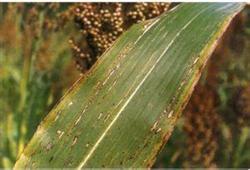
What does bacterial stripe disease of sorghum look like? Please explain. The symptoms of bacterial stripe disease of sorghum mainly affect sorghum leaves and leaf sheaths. Lesions form light red to light purplish-red stripe-like patterns along the leaf veins, about 1-3mm wide. In a few varieties they are yellowish-brown; the lesions are shiny and not water-soaked, which distinguishes them from bacterial red stripe disease. When lesions are numerous...
What does bacterial stripe disease of sorghum look like? Please explain
Symptoms of bacterial stripe disease of sorghum mainly affect sorghum leaves and leaf sheaths. Lesions form light red to light purplish-red stripe-like patterns along the leaf veins, about 1-3mm wide. In a few varieties they are yellowish-brown; the lesions are shiny and not water-soaked, which distinguishes them from bacterial red stripe disease. When lesions are numerous, they form large red patches, causing diseased leaves to turn red and dry up. It occurs commonly in Hebei, Shanxi, Shandong, Henan, Jiangsu and other provinces in China.
The pathogen is called Pseudomonas sorghi, a bacterium. The bacterial cells are rod-shaped, measuring 1-2 x 0.5-0.7 (um), with 1 or rarely 2 polar flagella, and a sheathed flagellum is often visible; it does not produce fluorescent pigment, has no capsule, no spores, is Gram-negative, and is aerobic. On nutrient agar plates the colonies are round, white, slightly glossy, with entire, smooth, semi-transparent margins, and slightly raised. The optimum growth temperature is 5-38°C, with the optimum at 22-28°C, and the thermal death point is 50°C. Besides harming sorghum, it can also infect corn and other grass family plants.
Click to get more sorghum cultivation techniques
Click to get more grain cultivation techniques