How can black sesame be cultivated to achieve high yields?
How can black sesame be cultivated for high yields? Please provide guidance. For black sesame cultivation methods, you can refer to the following planting methods: 1. Land preparation and fertilization. Choose a field with high terrain and good drainage, plough and harrow carefully, and apply sufficient base fertilizer in combination with land preparation: apply 10 kg of urea and 50 kg of phosphate and potassium fertilizer per 667 sq m. Level and harrow until fine, then wait...
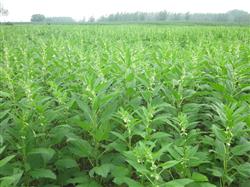
How can black sesame be cultivated for high yields? Please provide guidance
For black sesame cultivation methods, you can refer to the following planting methods:
1. Land preparation and fertilization. Choose a field with high terrain and good drainage, plough and harrow carefully, and apply sufficient base fertilizer in combination with land preparation: apply 10 kg of urea and 50 kg of phosphate and potassium fertilizer per 667 sq m. Level and harrow until fine, then wait for sowing.
2. Sowing. The sowing period for black sesame includes spring sowing and summer sowing. Spring sowing is around Grain Rain, and summer sowing is around Grain in Ear, mainly after wheat stubble and rapeseed stubble. When sowing, sow the black sesame seeds evenly onto the prepared seedbed with a seed drill. The sowing rate is 1 kg per mu.
3. Field management. After black sesame seedlings emerge uniformly, attention should be paid to intertillage and weeding. For seedling-stage management, the "double-stem cultivation method" is mainly used. That is, when the third pair of true leaves of the sesame seedling is half-unfolded, remove the growing tip, and the axillary buds of the first (or second) pair of true leaves sprout and grow to form double stems. To use this method, the following points should be mastered. 1. Seed dressing with chemicals, crop rotation, and early sowing while preserving soil moisture. Before sowing, 8 g of 50% carbendazim wettable powder or 40% carbendazim suspension concentrate can be mixed with 0.5 kg of water into a paste, and stirred evenly with 0.5 kg of seeds for sowing. Black sesame should not be planted continuously; a 4-year 2-crop rotation system is recommended. Try to secure a good preceding crop and sow early. 2. Sow early at the appropriate time and control density. The sowing period for summer sesame should be no later than June 15, and generally the earlier the better. The cultivation density is generally 8000-10000 plants per 667 sq m. 3. Strictly master the time and method of topping. For summer sesame, retain 2 pairs of true leaves when topping, and retain 2-3 cm of stem nodes above the leaves. In the same field, keep the standard for retained true leaves consistent, and complete topping in one go. 4. Pay attention to supplementary seedling fertilizer: after topping sesame, to prevent new branches from suffering fertilizer deficiency, appropriate quick-acting fertilizer can be applied: when the new branches grow the second and third pairs of true leaves, spray 100-fold diluted mepiquat chloride or paclobutrazol to prevent later lodging and increase the number of effective capsules. 5. Prevent waterlogging, resist drought, carry out early intertillage and early management, and prevent weed infestation. When planting, first open the bed furrows and surrounding furrows. Generally, the bed surface width is 2-2.5 m, and the bed furrow depth is 0.3 m. The surrounding furrow depth is 0.4-0.5 m. When the seedlings grow 2-3 pairs of true leaves, thin them to a fixed stand, with row and plant spacing of 36 cm x 12-15 cm, and carry out intertillage and weeding once. When the seedlings are 33 cm tall, earth up in combination with topdressing. 6. Scientific fertilization and prevention of diseases and pests. Summer sesame has a short growth period and requires much fertilizer in a concentrated way, so more base fertilizer should be applied. Apply about 10 kg of urea, 30-40 kg of phosphate fertilizer, and about 10 kg of potassium fertilizer per 667 sq m. During the growing period, for fields with sparse seedlings and weak growth, 3-5 kg of urea can be topdressed per 667 sq m. At the jointing stage, to prevent angular leaf spot and leaf blight, 1000-fold diluted 50% iprodione can be sprayed on the leaves twice. If aphids occur, 2000-3000-fold dimethoate emulsifiable concentrate can be sprayed.
4. Harvesting and processing. Black sesame is generally harvested after the aboveground stems and leaves mature in autumn, cut off from the ground. Cut the black sesame close to the roots, tie into small bundles, dry in the sun, then thresh the black sesame, dry in the sun, winnow away impurities, and it becomes a commodity for sale.
Click to get more sesame cultivation techniques
Click to get more food crop cultivation techniques