Detailed Explanation of Key Points for High-Yield Cultivation Techniques of Kudzu
Kudzu, also known as fen ge, with its vine belonging to the genus Pueraria in the Fabaceae family, is rich in starch, isoflavones, and more than ten kinds of trace elements essential to the human body such as calcium, selenium, iron, copper, phosphorus, and potassium. It has effects such as "relieving exterior symptoms and reducing fever, promoting fluid production and quenching thirst, stimulating appetite and aiding digestion, treating hemorrhoids, and preventing cancer." It is an emerging green health and longevity food...
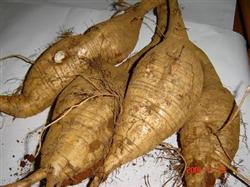
Kudzu, also known as fen ge, with its vine belonging to the genus Pueraria in the Fabaceae family, is rich in starch, isoflavones, and more than ten kinds of trace elements essential to the human body such as calcium, selenium, iron, copper, phosphorus, and potassium. It has effects such as "relieving exterior symptoms and reducing fever, promoting fluid production and quenching thirst, stimulating appetite and aiding digestion, treating hemorrhoids, and preventing cancer." It is an emerging green health and longevity food and a tight export product. Every part of the kudzu plant is useful: the stem bark fiber can be twisted into rope, woven into kudzu cloth, and also used as papermaking material; the leaves are excellent green feed and can be used to feed pigs and rabbits; the kudzu residue can be used for cultivating edible fungi; the tubers are rich in starch and can be processed into health foods or brewed into kudzu wine; kudzu flowers can be made into kudzu flower tea with a remarkable effect of counteracting alcohol. It has an inhibitory effect on various postpartum diseases in women, and also has breast-enhancing and beauty effects.
The artificial cultivation experience is introduced as follows:
Due to different planting terrains, one of the cultivation methods can be selected according to the different terrain.
I. Trellis method:
This method is suitable for planting in wasteland, farmland, in front of and behind houses, vegetable gardens, and other low-lying land.
(1) Selecting good varieties:
Focus on established high-yield kudzu varieties, supplemented by local folk-cultivated varieties. Absolutely do not take the easy way out by planting wild kudzu or local varieties with coarse fiber. It is best to choose those that show results in the same year. Otherwise, it will result in low benefits and inability to mechanically process.
(2) Plastic film seedling cultivation:
(a) Preparation of nutrient seedbed: It is better to choose sandy loam soil in mountainous areas or garden plots that are sheltered from wind and facing the sun, with no harm from livestock and poultry, as the seedbed. Heavy clay soil tends to accumulate water, so some sand can be mixed in to improve the soil. Level the seedbed into ridges 15-20 cm high and 60-100 cm wide, with unlimited length. Apply 1.5-2.5 kg of decomposed barnyard manure or farmyard manure per square meter. Deeply plow and level, with the middle of the seedbed slightly raised and ditches on both sides 20-30 cm wide.
(b) Sowing operation: (1) The seedbed must be fully moistened before sowing; (2) Take the selected fine variety of kudzu vine stems, use one axillary bud as one seed, cut the bud nodes into small sections 6-10 cm long, and scatter them on the prepared seedbed, avoiding overlap. Cover with 2-3 mm of fine soil on top, in principle achieving a state where they are partly hidden and partly visible. Then broadcast some decomposed barnyard manure and cover with a layer of rice straw; (3) Use bamboo strips or small bamboo slivers about 2 m long to insert into the seedbed in an arch shape, inserting one every 35 cm. Cover with agricultural film, fully covering the seedbed into an arch shape, and press down the surrounding edges with soil.
(3) Land selection and preparation:
(a) Land selection: To obtain high yield in artificial kudzu cultivation, the first step is to select good land. First, sweet potato fields can be used for conversion to kudzu planting; second, choose sandy loam soil with a relatively thick soil layer and good drainage for planting.
(b) Land preparation and ridging: Begin land preparation and ridging in mid-February. Before land preparation, apply 400 kg of barnyard manure, 500 kg of stove ash, and 50 kg of calcium-magnesium phosphate fertilizer per mu, or apply 200 kg of compound fertilizer. During land preparation, as with sweet potato ridges, a ridge width of 60-70 cm is appropriate, and the ridge length is determined by convenience of land operations.
(4) Reasonable close planting:
Late February to mid-March. Choose an overcast day or a sunny day without strong wind for transplanting. Before transplanting, water the seedbed thoroughly so that seedlings can be lifted with soil balls. Plant 1200-1400 plants per mu, that is, a plant spacing of 30 cm, with row spacing determined by the terrain. Remember, the plants must be planted at a 30-degree angle. Planting this way results in fast growth, easy digging, and labor savings. Before planting seedlings, first place the seedlings on the ridge according to plant spacing, then dig small holes, place the seedlings into the holes, cover with 2 cm of fine soil, and press the soil firm with both hands.
(5) Strengthening management:
(a) Trellising: When the seedlings grow to 10-20 cm high, trellising should be done. Trellis materials can be bamboo strips or firewood sticks about 2 m long. Insert them diagonally and crosswise in rows, connecting into a continuous sheet. At the crossing points of the bamboo strips, reinforce with rope to prevent wind and damage by people and livestock.
(b) Fertilization: After transplanting the seedlings, diluted human and livestock manure water can be appropriately used as root-setting water. When the seedlings grow to about 30 cm, they must be stimulated twice with 0.3%-0.5% urea water spray, once every 15 days. After that, appropriate additional fertilization can be applied.
(c) Intertillage, weeding, and pest and disease control: When the kudzu vine grows to 1-2 m, intertillage and weeding should be carried out. Although kudzu has strong stress resistance, some pests and diseases inevitably appear, especially in the key season of tuber growth from June to August. To maintain vigorous leaves, carry out residue-free chemical control when necessary or use lime powder for control.
(6) Pruning:
When the kudzu vine grows to about 1.5 m, the branches and vines must be pruned.
(a) Root pruning: Scrape away the surface soil at the base, and when the tuberous root tips are visible, select 1-2 thick, strong root tubers to keep, cut off the remaining root system with a blade, and then cover the surface soil back.
(b) Branch pruning: Keep 1-2 thick, strong vines per plant as the main vine, and cut off all others. Lateral bud vines within 1-1.5 m of the main vine from the root should also be cut off, so that the base does not grow new tender branches. When the main vine grows to 5 m long, cut off the top to ensure nutrients promote tuber expansion.
(7) Harvesting and seed preservation:
Kudzu can be dug in the same year or the second year. Generally, the starch content is highest when dug in November-December. Kudzu is mainly propagated asexually. Select thick, strong, pure vine stems from the nodes as seed vines for the next year. Generally, any part from 1.5 m above the base can be used as seed vines.
II. Open-field cultivation method:
This method is only suitable for planting on gentle slopes of less than 30%. The planting requirements are basically the same as the trellis method, except that trellising, root pruning, and branch pruning are omitted, allowing it to grow naturally and cover the ground, enhancing drought resistance, which is beneficial for soil and water conservation, and allows yearly digging of the large and keeping the small. For the same piece of land, the goal is to invest once and benefit for generations.