What causes the quality deterioration of summer cauliflower?
What causes the quality deterioration of summer cauliflower? Please give an introduction. In summer production of cauliflower, quality deterioration is often caused by the influence of environmental conditions and improper cultivation measures. Over many years of growing cauliflower, some experience in preventing and controlling common cauliflower quality deterioration has been accumulated, and it is now introduced here for everyone's reference....
What causes the quality deterioration of summer cauliflower? Please give an introduction
In summer production of cauliflower, quality deterioration is often caused by the influence of environmental conditions and improper cultivation measures. Over many years of growing cauliflower, some experience in preventing and controlling common cauliflower quality deterioration has been accumulated, and it is now introduced here for everyone's reference.
Split curd and black heart. Split curd means the inner part of the curd splits open, the flower branches are hollow inside, and scattered water-soaked brown spots often appear on the surface of the curd. It tastes bitter, the small leaves around the curd develop incompletely, the leaf margins curl, and small cracks appear on the leaf stalks. This is mainly caused by boron deficiency in the soil. Potassium deficiency in the soil easily causes black heart in cauliflower. Control methods: Before cauliflower transplanting, apply fertilizer to the soil according to a nitrogen-phosphorus-potassium formula, promote the use of organic-inorganic compound fertilizer as base fertilizer, and at the same time apply 0.25-0.5 kg of borax or boric acid per mu in the base fertilizer. During the growing period, when plants or curds show symptoms of boron or potassium deficiency, spray 0.2%-0.3% borax solution or 0.2% potassium dihydrogen phosphate solution on the leaves, once every 5-7 days, for 3 consecutive sprays.
Loose curd. The flower stalks and flower branches develop relatively quickly, resulting in a loose curd. Causes: During the heading period, the temperature is too high, the expansion of the curd is inhibited, while the flower stalks and flower branches grow rapidly, and after elongation they cause the curd to loosen; the curd is not harvested in time after it has fully formed. Control methods: Sow at the appropriate time, and arrange the curd growth period in months with an average daily temperature of 15°C-23°C (that is, spring and autumn cultivation are preferable), so as to avoid the influence of high temperature during the heading period; harvest when the curd has fully formed and the edges have not yet opened. Where conditions permit, shade nets can be used to reduce the influence of high temperature during the heading period.
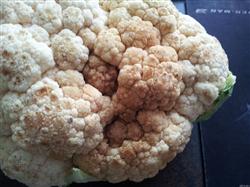
Yellow curd. In cauliflower production, the phenomenon of the curd turning yellow often occurs, mainly caused by strong light exposure on the curd. Control methods: When the curd grows to 3 cm in diameter, gently bend 1-2 outer leaves close to the curd so that they cover the curd; where conditions permit, shade nets can be used. Several leaves at the center of the plant can also be tied together at the upper ends with straw and so on, wrapping the curd to avoid direct strong light.
Click to get more cauliflower growing techniques
Click to get more vegetable growing techniques