What should be paid attention to when planting black sesame?
What should be paid attention to when planting black sesame? Please give guidance. When planting black sesame, pay attention to the following points: 1. Land preparation and fertilization: choose sandy loam or loam fields with loose soil, good air permeability, and medium-to-above-average fertility, and avoid continuous cropping. Prepare the land and fertilize at the end of May and early June, applying 10-15 kg of urea or 20-2... per mu.
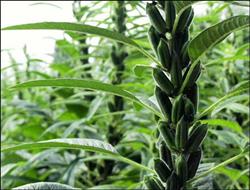
What should be paid attention to when planting black sesame? Please give guidance.
When planting black sesame, pay attention to the following points:
1. Land preparation and fertilization: choose sandy loam or loam fields with loose soil, good air permeability, and medium-to-above-average fertility, and avoid continuous cropping. Prepare the land and fertilize at the end of May and early June, applying 10-15 kg of urea or 20-25 kg of ammonium bicarbonate, and 5-10 kg of potassium chloride per mu.
2. Seed treatment: sun-dry the seeds for 1-2 days before sowing. To prevent sesame black spot disease and stem spot blight, soak the seeds in warm water at 50-55°C for about 15 minutes, remove them after cooling, dry them, and sow. The sowing rate is 0.5 kg per mu.
3. Thinning and final thinning: thin the seedlings when the first pair of true leaves unfolds. When 2-3 pairs of true leaves have grown, set the plants at a spacing of 15×20 cm between plants and rows, remove dense seedlings and fill in sparse areas, and keep 8000-10000 strong seedlings per mu.
4. Topping at the right time: 10-20 days after the initial flowering stage, remove about 1 cm from the top of the main stem and each branch.
5. Disease control: after black sesame buds appear, when the stems grow rapidly, spray with 50% iprodione 800-1000 times dilution, once every 5-7 days, for 2-3 consecutive applications, which can effectively control black spot disease, leaf blight, and stem spot blight.
6. Harvest at the right time: sesame matures very unevenly. If harvested too early, the upper seeds cannot mature; if harvested too late, the lower seeds are prone to shattering, causing losses. Harvest should be done half a month to 20 days after the final flowering stage, or about 5 days after topping. After harvesting, pile them for a period before threshing so the seeds can fully mature.
Click to get more sesame planting techniques
Click to get more food crop planting techniques