How is artificial trellising carried out in kudzu root cultivation?
Artificial trellis cultivation of kudzu root is suitable for wasteland, farmland, in front of and behind houses, vegetable gardens and other low-lying land. (1) Select good varieties. Give priority to stabilized high-yield kudzu root, with local folk-cultivated varieties as a supplement; absolutely do not cut corners by planting wild kudzu or local varieties with coarse fiber. (2) Plastic film seedling raising 1. Preparation of nutrient seedling beds: choose...
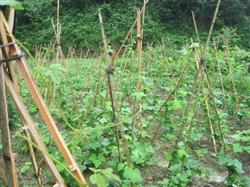
Artificial trellis cultivation of kudzu root is suitable for wasteland, farmland, in front of and behind houses, vegetable gardens and other low-lying land.
(1) Select good varieties. Give priority to stabilized high-yield kudzu root, with local folk-cultivated varieties as a supplement; absolutely do not cut corners by planting wild kudzu or local varieties with coarse fiber.
(2) Plastic film seedling raising
1. Preparation of nutrient seedling beds: it is better to choose sandy loam soil on mountain land or garden land that is sheltered from the wind and faces the sun, with no harm from livestock and poultry, as the seedling bed. Prepare the seedling bed land into ridges 15-20 cm high and 60-100 cm wide, with unrestricted length. Apply 15-25 kg of decomposed barnyard manure or farmyard manure per sq m. Deeply plow and rake level, with the middle of the seedling bed slightly raised, and the ditches on both sides 20-30 cm wide.
2. Seed placement operation: (1) Before seed placement, the seedling bed must be fully moistened; (2) take the selected fine kudzu vine stems of improved varieties, use one branch bud as one seed, cut the bud nodes into small sections 6-10 cm long, scatter them on the prepared seedling bed, avoid overlapping, cover with 2-3 mm of thick fine soil, half hidden and half visible. Then broadcast some decomposed barnyard manure, and cover with a layer of rice straw; (3) use bamboo strips or small bamboo slivers about 2 m long to insert into the seedling bed in an arch shape, inserting one every 35 cm. Cover well with agricultural film, fully covering the seedling bed into an arch shape, and compact the surrounding edges with soil.
3. Seedling bed management: after about 10 days, if the ridge surface is dry, water once. After the planted roots sprout branches, water about once every 3 days, and keep the seedling bed temperature at about 20°C. When the temperature reaches above 30°C, uncover the film for ventilation or spray water to regulate it. When the seed spikes sprout branches, uncover the covering rice straw, and provide appropriate shade at noon on sunny days. When the seed spikes produce tender branches, unfold 3 leaves, and reach a length of 5 cm, seedlings can be lifted with soil.
(3) Land selection and preparation. First, sweet potato land can be used for conversion to planting; second, choose sandy loam land with a relatively thick soil layer and good drainage for planting. Begin land preparation and ridging in mid-February. Before land preparation, apply 500 kg of barnyard manure, 500 kg of stove ash, 50 kg of calcium magnesium phosphate fertilizer, or 200 kg of compound fertilizer per mu. For land preparation, the ridge width is 60-70 cm, and the ridge length is determined by ease of operation.
(4) Reasonable close planting. From the end of the month to mid-March, choose a sunny day without strong wind among cloudy days for transplanting. Before transplanting, water the seedling bed thoroughly. Plant 1200-1400 plants per mu, with a plant spacing of 30 cm, and row spacing determined by the terrain. Remember, it must be planted diagonally at a 30-degree angle. Planted this way, it grows fast, is easy to dig, and saves labor. Before planting the seedlings, first arrange the seedlings on the ridge according to plant spacing, then dig small holes, place the seedlings into the holes, cover with 2 cm of fine soil, and press the soil firm with both hands.
(5) Strengthen management. When the seedlings grow to 10-20 cm high, trellising should be carried out. Use bamboo strips or firewood strips about 2 m long as trellis material, inserted diagonally and crossing into rows. After transplanting the seedlings, diluted human and livestock manure water can be appropriately used as settling water. When the seedlings grow to about 30 cm, they must be stimulated twice, and 0.3%-0.5% urea water can be sprayed, once every 15 days, after which additional fertilizer can be applied as appropriate. When the kudzu vines grow to 1-2 m, carry out intertillage and weeding. From June to August, use residue-free drugs or lime powder to prevent disease.
(6) Pruning. When the kudzu vines grow to about 1.5 m, scrape away the surface soil at the root crown, and when the tips of the tuberous roots are visible, select 1-2 thick strong root tubers to keep, cut off the remaining root systems with a blade, and then cover the surface soil well. Keep 1-2 thick strong vines per plant as the main vines, and cut off all the others. Lateral bud vines within 1-1.5 m of the main vine from the root should also be cut off, so that the root crown does not grow tender branches again. When the main vine grows to 5 m long, cut off the top.
(7) Harvest and seed retention. Kudzu root can be dug in the same year or in the second year; generally, the starch content is highest when dug in November-December. Kudzu root is mainly propagated vegetatively. For nodes, select thick, pure plant vines as seed vines for the second year; generally, everything from 1.5 m above the root crown can be used as seed vines.