Detailed Explanation of the Key Cultivation Techniques for Fast-Growing Kudzu Root
Kudzu is a leguminous vine plant, and every part of it is valuable, with extremely high economic value. Among them, kudzu powder is a specialty health food that combines nutrition, dietary therapy, and deliciousness, and through deep processing it can also be made into more than a dozen kinds of exquisite foods; kudzu leaves are rich in plant protein and belong to complete feed; kudzu flowers are a precious medicinal material and a good remedy for sobering up. Kudzu has a short growth cycle...
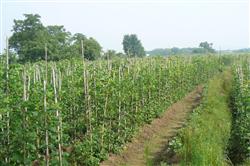
Kudzu is a leguminous vine plant, and every part of it is valuable, with extremely high economic value. Among them, kudzu powder is a specialty health food that combines nutrition, dietary therapy, and deliciousness, and through deep processing it can also be made into more than a dozen kinds of exquisite foods; kudzu leaves are rich in plant protein and belong to complete feed; kudzu flowers are a precious medicinal material and a good remedy for sobering up. Kudzu has the characteristics of a short growth cycle and high yield. The variety characteristics and key cultivation techniques of "fast-growing kudzu root" are introduced as follows:
I. Variety Characteristics
The tuberous roots are large, the stems and vines are thick, the leaf surface is broad and large, and the fuzz is white. It has wide adaptability, adapts to growth in various soils, is tolerant of drought and waterlogging, and has no pests or diseases. After planting, small kudzu grows all over the stem nodes every year, with extremely strong vitality, and each plant produces 10 kg-20 kg of kudzu root.
II. Key Cultivation Techniques
1. Land selection. Deep-soil barren hills and slopes, riverside embankments, field edges and corners, and the areas in front of and behind houses can all be used for planting. Before cultivation, weeds and shrubs must be strictly cleared, especially wild kudzu. This is because wild kudzu will affect the effective use of the ground, and at the same time, when the roots are harvested, if wild kudzu is mixed in, because its fiber is coarse and hard, it will jam the grinder and make mechanized powder production impossible.
2. Digging trenches (holes). The planting trenches (holes) are 30 cm-40 cm wide and deep, and the spacing between two trenches (holes) is 1 m.
3. Planting. During the planting period (February to late April), plant (insert) plant seedlings (with roots) or cut seedlings (containing 2 stem nodes, which can be propagated by cuttings, without roots) into the furrow trenches (holes), planting 650-700 plants per mu. For plant seedlings, plant them into the soil at a 30-degree angle to the ground; cut seedlings are also inserted into the soil at a 30-degree angle, but of the two stem nodes, one must be in the soil and one outside the soil. After planting, water to settle the roots.
4. Growth management. After sprouting, protect the seedlings and apply fertilizer (diluted human waste), and it is advisable to apply fertilizer in small amounts many times. In mid-May (according to actual field conditions), carry out one intertillage, weeding, and hilling. Because of its strong vitality, high coverage, and strong nitrogen fixation, it generally does not need further intertillage and weeding. Each spring, an appropriate amount of fertilizer needs to be applied as a supplement.
5. Tuberous root harvest. In winter, nutrients concentrate in the tuberous roots, causing the tuberous roots to expand rapidly, so the soil at the base of the plant can be dug open directly from cracks in the ground to harvest the tuberous roots. When harvesting, harvest the large ones and leave the small ones, and after harvesting, cover them back with soil.