What is the sesame capsule borer? Get to know this sesame pest
What is the sesame capsule borer? Please introduce the sesame capsule borer, which is one of the main pests of sesame. It mainly damages sesame. It commonly occurs in major sesame-producing areas in China such as Henan, Hubei, Anhui and Jiangxi, generally reducing yields by 10%-20%, and by up to 30% in severe cases, causing a marked decline in sesame quality. In response to its occurrence, carefully study...
What is the sesame capsule borer? Please introduce
The sesame capsule borer is one of the main pests of sesame. It mainly damages sesame. It commonly occurs in major sesame-producing areas in China such as Henan, Hubei, Anhui and Jiangxi, generally reducing yields by 10%-20%, and by up to 30% in severe cases, causing a marked decline in sesame quality. In response to its occurrence, carefully study its occurrence patterns, do a good job of screening control pesticides, and explore control methods.
I. Occurrence patterns
In Henan, the sesame capsule borer has 4 generations a year, with overlapping generations, and overwinters as mature larvae. Adults appear from late July to late November, with the peak adult emergence period in early August. Adults are phototactic, mostly resting during the day on the undersides of sesame leaves or in weed clumps, and are active at night laying eggs. Eggs are laid singly on sesame leaves, stems, flowers, capsules and tender shoots, with an egg stage of 6-7 days. Larvae have migratory habits, feed on leaf mesophyll, and like to bore into flower centers and capsules to cause damage. The larval stage is about 15 days. Mature larvae spin light gray thin cocoons and pupate inside rolled leaves, in capsules or in stem crevices, with a pupal stage of about 7 days. Completing one generation takes 37-38 days.
II. Damage symptoms
Larvae spin silk to wrap flowers and leaves, feed on leaf mesophyll, and often bore into flower centers, tender stems and capsules to feed, and can eat the seeds completely, causing capsules to turn black and drop off and plants to wither and turn yellow.
III. Morphological characteristics
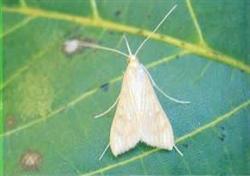
The adult sesame capsule borer is 7-9 mm long, light yellowish brown, with 3 indistinct yellowish brown spots near the leading edge, and two indistinct black spots on the hind wings. Eggs are about 0.4 mm long, oblong, initially milky white, later turning light yellow to pink. Larvae are 16 mm long, with a blackish brown head, and body colors of green, yellow-green, light grayish yellow and reddish brown. Pupae are about 10 mm long, light grayish green to dark greenish brown, with the ends of the proboscis and antennae separated from the body.
IV. Control methods
1. Agricultural control:
Clear weeds and dead branches and fallen leaves at field edges, roadsides and in fields. Practice rational crop rotation, and carry out paddy-upland rotation where conditions permit. Plow and harrow carefully to reduce overwintering sources of the pest. Irrigate at the seedling stage and flowering stage to increase soil moisture.
2. Chemical control:
(1) Fumigation: During the peak adult emergence period in early August, mix 100-150 g of 80% dichlorvos with 4 kg of sawdust and wheat bran, place 40 piles per mu, evenly piled under the sesame plants, which generally maintains efficacy for 8-10 days.
(2) Spraying: 7-10 days after the peak adult emergence period is the peak larval hatching period, when spraying gives the best control effect. Use 30-40 ml of 2.5% deltamethrin emulsifiable concentrate per mu; 20-30 ml of 20% fenvalerate emulsifiable concentrate; or 25-30 ml of 50% fenitrothion emulsifiable concentrate, mixed with 50 kg of water, diluted evenly and sprayed.
(3) Dusting: During the peak larval hatching period, use 1.5% dimethoate powder; 2.5% trichlorfon powder; 2% fenitrothion powder, 1.5-2 kg per mu, applied evenly with a duster.
Click to get more sesame cultivation techniques
Click to get more food crop cultivation techniques