How should micronutrient fertilizers be applied during sesame cultivation?
How should micronutrient fertilizers be applied when growing sesame? Please give guidance. The main trace elements needed during the growth and development of sesame include boron, zinc, manganese, iron and other elements, but the absorption amount differs at different growth stages. During the seedling stage, the absorption rate is slow and the accumulated amount is small; from the flowering stage to the topping stage, the absorption rate is fast and the accumulated amount is large; from topping to mat...
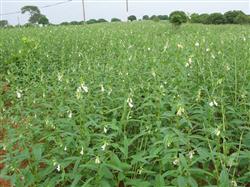
How should micronutrient fertilizers be applied when growing sesame? Please give guidance
The main trace elements needed during the growth and development of sesame include boron, zinc, manganese, iron and other elements, but the absorption amount differs at different growth stages. During the seedling stage, the absorption rate is slow and the accumulated amount is small; from the flowering stage to the topping stage, the absorption rate is fast and the accumulated amount is large; from topping to maturity, the absorption rate slows down again and the accumulation decreases. However, different elements also have their own characteristics. Zinc is absorbed the most during the topping stage, and manganese fertilizer is absorbed fastest after flowering. Throughout the entire growth and development process of sesame, iron is needed the most, followed by boron, then zinc, and manganese the least. According to the current soil testing and analysis in our city, zinc, molybdenum, manganese and boron are extremely deficient in the soil of our city, which will inevitably affect the growth and development of crops. Application techniques for different micronutrient fertilizers
For boron fertilizer, borax is usually used, and it can be applied as a base application, topdressing, or seed application. As a base fertilizer, generally 0.5-0.7 kg per mu is applied; for seed dressing, the general dosage is 0.4%-0.6% of the seed weight; the concentration of the soaking solution is 5%, and the soaking time is 20-24 hours; for foliar topdressing, it is suitable to spray 2-3 times from the early flowering stage to before full bloom, with a concentration of 0.1%-0.2%.
For zinc fertilizer, zinc sulfate is commonly used, with 1-2 kg applied as a base application per mu, and 4-6 g per kg of seed for seed dressing. If sprayed on the leaves, the concentration is 0.1%-0.5%, and spraying at the bud stage has a better effect, that is, spraying 25-30 days after emergence.
For manganese fertilizer, manganese sulfate is commonly used. Manganese fertilizer should be applied early. If manganese fertilizer is applied in the middle and late stages, it is difficult to correct manganese deficiency. Generally, 0.5-0.75 kg is applied as a base application per mu, and 6-7 g of manganese sulfate is used per kg of seed for seed dressing. For foliar spraying, the effect is better 7-10 days before budding.
Iron fertilizer is mainly ferrous sulfate. For applying iron fertilizer, foliar spraying is preferable, and the commonly used concentration is 0.1%-0.5%.
In order to improve the effect of foliar fertilization, first determine the appropriate number of sprayings. Generally, trace elements are sprayed 2-3 times, with an interval of 7-8 days. Second, choose a suitable time for spraying. It is best to spray on cloudy days. If spraying on sunny days, it should be done before 9 a.m. when there is no wind, or after 4 p.m. Third, add the necessary sticking agent. Add a small amount of washing powder to the prepared fertilizer solution as a sticking agent. However, note that alkaline washing powder must not be added. Adding organic substances such as acetone and ethanol can also reduce the surface tension of the fertilizer solution, increase the leaf contact area, and improve fertilizer efficiency. In addition, it is best not to mix and spray several trace elements together, so as not to reduce fertilizer efficiency.
Click to get more sesame cultivation techniques
Click to get more food crop cultivation techniques