Goji berry has a wide range of adaptability and is simple to plant.
Goji berry has strong sprouting ability. Every year from April to August, while many new branches are produced, suckers also grow from the roots. Goji berry is highly cold-resistant, sun-loving, and salt-alkali tolerant. Its propagation is divided into two types: sexual reproduction and asexual reproduction. For sexual reproduction, soak the fruit in water for 1-2 days, and after it softens, wash out the seeds and dry them in the sun. Sow in late March, cover with 1 cm of soil...
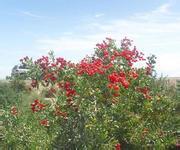
Goji berry has strong sprouting ability. Every year from April to August, while many new branches are produced, suckers also grow from the roots. Goji berry is highly cold-resistant, sun-loving, and salt-alkali tolerant.
Its propagation is divided into two types: sexual reproduction and asexual reproduction.
For sexual reproduction, soak the fruit in water for 1-2 days, and after it softens, wash out the seeds and dry them in the sun. Sow in late March, cover with 1 cm of soil, and spray water immediately after treading down. Seedlings emerge 7 days after sowing. Thin the seedlings after emergence, and transplant in the spring of the second year.
Asexual reproduction can be done by cuttings or division, and it reproduces quickly and bears fruit early. Cutting propagation is more common. Collect one-year-old lignified branches with a thickness of more than 0.3 cm from superior mother trees, cut them into 18-20 cm long cuttings, insert them obliquely into the seedbed, and keep them moist. The survival rate is high, and they can bloom in the second year. Transplanting is carried out in April and they survive very easily.
It is suitable for planting in well-drained calcareous loam, and clay soil should be avoided. During the growing period, give it more sunlight and control watering. If it is too shady and damp, growth will be poor. During the flowering and fruiting period, ensure sufficient water, and irrigate once each time a batch of fruit is picked.
In summer, goji berry is prone to rust disease, so Bordeaux mixture should be applied once every 10 days in spring for prevention and control. The fruit matures successively from June to November, and should be harvested in time and dried in the sun or by heat for later use.