What are the medicinal benefits of goji berry? A detailed guide to growing techniques
Goji berry is an important economic plant and an excellent dual-purpose medicinal and edible product. In China, there are 7 species distributed: Ningxia goji (Lycium barbarum), Chinese wolfberry (Lycium chinense), black goji (Lycium ruthenicum), ** goji, Lycium truncatum, Lycium cylindricum, and Yunnan goji. Among them, 3 have traditional medicinal value: yellow-fruited goji (a variety of Ningxia goji), northern goji (a variety of Chinese wolfberry), and red-branched goji (a variety of ** goji).
Goji berry is an important economic plant and an excellent dual-purpose medicinal and edible product. In China, there are 7 species distributed: Ningxia goji (Lycium barbarum), Chinese wolfberry (Lycium chinense), black goji (Lycium ruthenicum), ** goji, Lycium truncatum, Lycium cylindricum, and Yunnan goji. Among them, 3 varieties have traditional medicinal value: yellow-fruited goji (a variety of Ningxia goji), northern goji (a variety of Chinese wolfberry), and red-branched goji (a variety of ** goji).
The tender leaves of goji berry can be used as a vegetable; the fruit is sweet and edible, and can be processed into health drinks and foods. The fruit, leaves, roots, and bark can all be used medicinally. The fruit has the effects of nourishing the kidneys, regulating the lungs, tonifying the liver, and improving eyesight, and is mainly used to treat liver-kidney yin deficiency, soreness and weakness of the waist and knees, dizziness, blurred vision, consumptive cough, and spermatorrhea. Goji leaves have the effects of tonifying deficiency and boosting essence, clearing heat, quenching thirst, dispelling wind, and improving eyesight, and are mainly used to treat consumptive fever, excessive thirst, red eyes with dim vision and pain, and heat-toxin sores and swellings. Goji root bark (Digupi) has the effects of clearing heat, reducing fever, cooling the blood, and lowering blood pressure, and is mainly used to treat consumptive tidal fever, night sweats, lung-heat cough and asthma, blood heat, high blood pressure, and malignant sores.
II. Propagation Methods
1. Direct seeding for afforestation. Drill sowing or hole sowing, sown in spring from late March to April after the soil thaws. Sowing depth 1-3 cm. Goji seedlings are easily eaten by livestock, which pull them up roots and all, so grazing must be prohibited.
2. Seedling raising and transplanting. Spring and autumn are the best seasons for raising seedlings.
3. Cuttings and layering. Goji roots have particularly strong sprouting ability. Goji branches growing on barren slopes can be soaked for 2-3 days, then cut into cuttings 0.5-1 cm thick and 30-50 cm long for rooting.
4. Propagation by tillering. Cut off the main trunk above the main root crown of a 2-year-old goji plant, and by the second year many young branches will sprout. The main root can also be cut off, and many young branches sprouting from both cut ends of the main root can be used for propagation. Spring is the best time for root cutting.
III. Cultivation Management
1. Planting density. On poor, thin soil, plant spacing is 1.5-3 m; on fertile soil, plant spacing is 2-3 m.
2. Soil and water-fertilizer management. From 2-5 years after planting, goji is in the early fruiting stage; deep plowing to cut the main root helps new branches sprout. Goji must be fertilized twice a year: apply base fertilizer after leaf drop and before bud break, and apply topdressing during flowering and fruit set, with irrigation after fertilizing.
3. Shaping and pruning. Goji enters the full fruiting stage starting in the 5th year. In the year of planting, shorten all branches, leaving 4-5 well-developed buds on each branch. In the 2nd and 3rd years, thin and shorten side branches and extension branches so that the branches grow thick and strong, with uniform density and good ventilation and light penetration.
Pruning principles:
① Cultivate and maintain 15-20 main framework branches in the plant cluster, maintain good light conditions within the cluster, and cut out overly dense branches.
② For basal branches, cut off 1/3-1/2 of their total length to train them into framework branches; for extension branches and new shoots on framework branches, cut off the top 3-5 buds depending on growth vigor.
③ In order to cultivate long-lived and strong framework branches, basal branches must be controlled; therefore, when pruning, remove the buds at the base and keep only the buds intended for renewal.
④ Branches that are pest-infested, injured, or too weak should be removed as early as possible, while new branches are kept to replace them.
IV. Main Goji Diseases and Their Control
1. Black fruit disease. Infection with anthracnose causes the fruit to turn black. Spray with 80% Tuzet at 1000x dilution or zineb at 500x dilution, or use Bordeaux mixture for control.
2. Gummosis. Mechanical injury causes branch and trunk rot with oozing of sticky sap. Apply Bordeaux mixture at 1:1:15 to the gummosis sites.
3. Gall mites. They damage tender shoots, leaves, flowers, and fruit, causing galls on them and affecting growth and development. When new leaves open in early spring, spray with dicofol at 500-800x dilution, or 80% dichlorvos at 1000-1500x dilution, or 25% chlordimeform at 500x dilution.
4. Fruit-boring insects. They damage fruit, flower buds, and tender shoots, causing damaged flower buds to fail to bloom and set fruit. Spray with 40% dimethoate or 80% dichlorvos at 1000-1500x dilution, or trichlorfon at 800-1000x dilution, or chlordimeform at 300x dilution to kill the larvae.
V. Harvesting and Processing
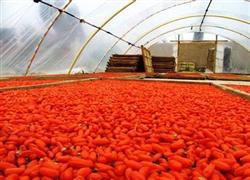
1. Harvesting and processing of goji fruit. Goji should be harvested between Grain in Ear and Autumn Equinox. Pick ripe fruit and dry it in the shade or in the sun. Be careful not to rub it with your hands, as this affects quality. Dry until the fruit skin is dry and the flesh is soft; in rainy weather, it can be dried by fire.
2. Preparation of Digupi (goji root bark). Dig the roots and take the bark at the Beginning of Spring when the ground thaws; at this time the quality is good and the bark is easy to peel. After Pure Brightness, the quality of Digupi is poorer. After the root bark is peeled off, dry it in the sun, or cut it into pieces while fresh and dry in the sun.