How to control anthracnose in Chinese cabbage (napa cabbage) in summer and autumn?
How to control anthracnose in Chinese cabbage in summer and autumn? Please provide an introduction to the control methods. In summer and autumn, anthracnose of Chinese cabbage not only harms Chinese cabbage, but can also harm mustard, radish, turnip and other cruciferous vegetables, affecting the marketability of the vegetables and causing reduced yields. Chinese cabbage anthracnose is a high-temperature, high-humidity disease, at temperatures of 26°C~30°C...
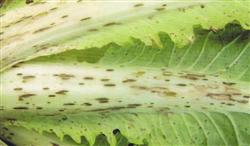
How to control anthracnose in Chinese cabbage in summer and autumn? Please provide an introduction to the control methods
In summer and autumn, anthracnose of Chinese cabbage not only harms Chinese cabbage, but can also harm mustard, radish, turnip and other cruciferous vegetables, affecting the marketability of the vegetables and causing reduced yields. Chinese cabbage anthracnose is a high-temperature, high-humidity disease. It is prone to occur at temperatures of 26°C~30°C, relative humidity above 95%, in continuous cropping fields, low-lying terrain, poor drainage, excessive planting density, poor fertilizer quality, weak plant growth, and poor ventilation and light penetration.
Symptom identification
On the leaves, the initial symptoms are pale white or chlorotic water-soaked small spots, which after expanding become round or nearly round, with brown edges, slightly raised, slightly sunken in the center, grayish white, papery, semi-transparent; in the later stage the lesions are grayish white, semi-transparent, and easily perforated. When it harms the veins on the underside of leaves, brown streaks of varying lengths appear, slightly sunken. When the petioles, flower stalks, and seed pods are affected, long oval or spindle-shaped to shuttle-shaped, brown or grayish brown sunken lesions are produced. When moist, the diseased parts often bear reddish-brown sticky matter.
Control measures
In the early stage of the disease, spray 2% antimycin aqueous solution at 200 times dilution, once every 5~6 days, for 2~3 consecutive sprays. You can also spray 80% ziram wettable powder at 600~800 times dilution, or 50% meimailing wettable powder at 600~800 times dilution, or 50% lide wettable powder at 600~800 times dilution, which can simultaneously control gray mold, sclerotinia and other diseases. In addition, you can spray 40% duofengnong wettable powder at 400~500 times dilution, or 70% thiophanate-methyl wettable powder at 1000 times dilution plus 75% chlorothalonil wettable powder at 1000 times dilution, or 50% benomyl wettable powder at 1000 times dilution, or 70% mancozeb wettable powder at 500 times dilution, or 25% prochloraz emulsifiable concentrate at 3000~4000 times dilution, once every 7~10 days, for 2~3 consecutive sprays.
Click to get more Chinese cabbage growing techniques
Click to get more vegetable growing techniques