Key Technical Points for High-Yield and High-Quality Cultivation of Goji Berry
Goji berry is a perennial deciduous shrub of the genus Lycium in the Solanaceae family. Its leaves, fruit, roots and bark all have extensive medicinal value. It has strong stress resistance and tolerates fertilizer and water well; it is suitable for planting in arid, sandy wasteland and saline-alkali land, and is also an excellent tree species for courtyard economies. Its fruiting period is long; planted in the same year, it can bear fruit for up to 50 years, and enters full fruiting at 3-4 years. A...
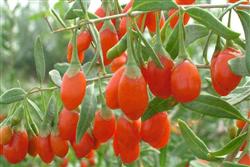
Goji berry is a perennial deciduous shrub of the genus Lycium in the Solanaceae family. Its leaves, fruit, roots and bark all have extensive medicinal value. It has strong stress resistance and tolerates fertilizer and water well; it is suitable for planting in arid, sandy wasteland and saline-alkali land, and is also an excellent tree species for courtyard economies. Its fruiting period is long; planted in the same year, it can bear fruit for up to 50 years, and enters full fruiting at 3-4 years. Generally, the yield of dried fruit per hectare can reach more than 3000 kg. Its fruit contains a variety of organic compounds and nutrients, and has effects such as tonifying the kidney, nourishing the liver, improving eyesight, promoting blood circulation and fighting cancer.
① Select improved varieties. There are many varieties of goji berry; in ** alone there are nearly 10. To achieve high quality and high yield, variety selection should be done well. In the early and middle ten days of the month, from plants of the Maye or Damaye varieties that have green leaves, short and thick fruiting branch internodes, few thorns, robust growth and no pest or disease damage, pick mature fruits that are large, bright red and relatively high in sugar content and keep them as seed. Pick the fruits, mash them, add clean water and wash, float off the fruit skin and flesh, filter off the juice, then wash the seeds clean and dry them in a dry, ventilated place for later use. Alternatively, from plants of these varieties, select branches with short internodes, correct color, robust growth, full buds and no pests or diseases, cut them into 20 cm lengths and keep them for cutting propagation. You can also directly dig up root-sucker plants around the base of superior variety trees for field planting.
② Cultivate strong seedlings. Choose fertile sandy loam as the nursery, apply 60,000-75,000 kg of organic fertilizer per hectare, and irrigate well. Make small beds with an area of 10-20 sq m, and sow on flat beds in April at a seeding rate of 1500-2250 g. Open furrows 4 cm wide and 1 cm deep on the bed surface, mix the seeds evenly with 10 times their volume of fine sand and scatter them into the furrows, cover with 0.5 cm of fine moist soil, firm it, then cover with wet chopped grass to prevent moisture loss. The plant and row spacing is 10 cm x 40 cm, and more than 225,000 seedlings per hectare should be maintained. Strengthen water and fertilizer management, loosening of soil and weeding, and thinning and final thinning of seedlings. When the seedlings grow to 60 cm tall, remove all young shoots below 50 cm; when they reach 75 cm in height, pinch the tips to shape them, and robust seedlings will be obtained.
③ Rational close planting. From late March to early April, use the method of ridge planting with furrow irrigation on both sides for field planting, with a plant and row spacing of 1.5 m x 2 m, planting about 3300 plants per hectare. Dig holes 40 cm x 40 cm x 40 cm, place 2-3 cm of decomposed farmyard manure mixed with sieved soil into the holes, cover the fertilizer with 10 cm of fine sieved soil, then plant upright, robust goji berry seedlings with 3-5 fibrous roots into the holes, cover with soil, firm it, and irrigate promptly to increase the survival rate.
④ Intertillage and weeding. Carry out spring plowing and autumn plowing in April and September each year respectively, to a depth of 20 cm. From May to July, carry out intertillage and weeding 4-6 times, to a depth of 6-8 cm. This helps eliminate pests, diseases and weeds, loosen the soil, and ensure normal growth and development of goji berry. In the orchard, except for the year of planting when melons, sugar beets or short-statured crops may be intercropped, intercropping with other crops is strictly prohibited thereafter.
⑤ Fertilizer and water management. Goji berry fruiting is divided into summer fruit and autumn fruit, so fertilizer and water have a great influence on the yield and quality of goji berry and should be taken seriously. For goji berry more than three years old (full fruiting stage), the annual fertilizer application per hectare (8-9 times) must ensure 350 kg of urea; 3000 kg of diammonium phosphate or triple superphosphate; and more than 37,000 kg of high-quality barnyard manure. Apply as topdressing separately before sprouting, flowering and fruit enlargement, and apply 1 basal fertilizer in autumn. According to the age of the tree, dig holes or ring-shaped trenches 20-30 cm deep at a distance of 20-60 cm from the trunk, apply the fertilizer into the holes or trenches, cover with soil after application, and irrigate promptly. In addition to deep soil fertilization, foliar spraying also has a clear effect on increasing the 1000-grain weight of the fruit. Spray 4 times during the first fruiting period in June-July, and 2 times during the second fruiting period in August-September. Each time apply 750-1500 g of potassium dihydrogen phosphate per hectare plus 750 g of urea, mixed with 750 kg of water; at the bud stage, spray 15 sticks (5 mL) of Yemianbao per hectare plus 750 kg of water. In addition to timely irrigation after topdressing and irrigation required after each fruit picking, generally irrigate once about every 12 days, and once every 7 days during the picking period, with about 600-900 cubic m of water each time, so as to achieve thorough summer irrigation and good winter irrigation.
⑥ Training and pruning. Training, pruning and pinching of goji berry play a great role in regulating reproductive growth and vegetative growth. Current-year and two-year-old fruiting branches have the strongest fruiting ability, and perennial and two-year-old spring branches are the best. Grasping these fruiting habits has an important guiding role for rational pruning. Pruning principles: pruning includes two parts, training and branch cutting. Adopting rational pruning can effectively improve the ventilation and light conditions inside the canopy, and plays an important role in accelerating canopy formation and expansion and balancing tree vigor. It makes the tree grow robustly, enhances resistance, increases fruiting branches, promotes vigorous new shoots, prevents excessive vegetative growth and premature aging, regulates the relationship between growth and fruiting, and promotes flower bud differentiation. Thus it enables young trees to bear fruit early and achieve early high yield, enables mature trees to be high-yielding and stable-yielding, prolongs the full fruiting period, and improves fruit quality. After training, the tree forms of goji berry can mainly be divided into the sparse stratified form, the natural open-center form, and the natural clump form, etc. The pruning requirements differ for different tree forms and for goji berry of the same tree form at different growth years. But no matter what, in the same year after planting, rational shaping should be carried out according to the tree form, so that the trunk, main branches, secondary branches and small branches are clearly layered. A goji berry plant can roughly be divided into 3-5 layers, with 25 cm between each layer, the tree body semicircular, the tree height about 1.6 m, and the canopy about 1.5 m. It is required to cultivate more fruiting branches, cut off non-productive branches, and grasp the pruning principle of three removals and three retainings, namely remove old and retain new, remove diseased and retain healthy, remove weak and retain strong, so that fruiting branches are evenly distributed within the canopy. Operation process: in the same year after planting, carry out rational shaping according to the growth of the seedlings.
Three tree form training methods. Sparse stratified form: set the trunk height at about 50 cm, with a central trunk, and remove all buds or branches sprouting below 20 cm from the top. At 20 cm from the top, select and retain 3 main branches, each about 10 cm apart, as the first layer; retain 2-3 secondary branches on each main branch; in the following year, select and retain 2-3 main branches upward on the trunk as the second layer, likewise retaining 2-3 secondary branches on each branch, and so on, with 3-5 layers possible. The topmost layer of main branches and secondary branches may be reduced by one. The tree height reaches about 1.6 m and the canopy diameter about 1.5 m. This tree form takes shape early. It is thick and strong, with a large fruit load. Natural open-center form: set the trunk height at 20 cm, with no obvious central trunk; select and retain 3 main branches at the base of the trunk, each about 15 cm apart, with an angle of about 30 degrees; retain 2-3 alternately distributed secondary branches on each main branch, each about 30 cm apart. Retain several slanting small branches on the main and secondary branches. The tree form can be formed in 2-3 years. This tree form has good ventilation and light transmission, bears fruit early, and has high yield and good quality. This training method is easy, requires little pruning, and is convenient to manage. Natural clump form: no central trunk; 3-4 main branches grow directly from the ground, each main branch alternately equipped with 3-4 secondary branches; except that the first secondary branch is 40-50 cm from the base of the main branch, the other secondary branches are each about 30 cm apart. Retain small fruiting branches on the main and secondary branches. This tree form has good ventilation and light transmission and helps make full use of space to achieve three-dimensional fruiting. Pruning and training cannot be separated. Pruning is further divided into autumn pruning, spring pruning and summer pruning. The pruning requirements for one-year-old, two-year-old and more than three-year-old goji berry are different and should be strictly controlled. Autumn pruning: the time is from mid-October to mid-November; according to the three removals and three retainings requirement, cut off non-productive branches and renew fruiting branches. This can increase the plant's nutrient reserves and raise the next year's yield. Spring pruning: the time is from late March to early April; it mainly makes up for insufficient autumn pruning of the previous year, cutting off all winter-killed and thorny branches; dense branches should be thinned to further improve the light conditions inside the canopy. For two-year-old goji berry, when spring pruning one-year-old branches, leave main branches 30-40 cm long, secondary branches about 20 cm long, and small branches in gaps on the main and secondary branches 8-10 cm long; branches in larger gaps; the key to the fruiting rate is mainly to select and retain two-year-old branches. Leave main and secondary branches 40-50 cm long and small branches 20-30 cm long. On secondary branches, leave one small branch about every 15 cm to cultivate fruiting branch groups. Through pruning, the canopy has been shaped. Summer pruning: the time is from June to August; mainly cut off sprouts, root suckers and water sprouts below pruning cuts and saw cuts and on main branches, the trunk and roots, so as to reduce nutrient consumption. But attention should be paid to retaining auxiliary fruiting branches used to fill space, to serve as main branches. When newly planted goji berry sends out secondary branches, or when old goji berry sends out new branches that grow to 40-60 cm, or when branches growing in canopy spaces reach 20-30 cm, pinching and tip pruning should be done in time; excess branches growing around should have their buds removed and sprouts eliminated in advance, so that nutrients are concentrated and flowering and three-dimensional fruiting inside and outside the canopy are promoted. This also prompts these branches to send out more new branches from the middle and lower parts, cultivating more fruiting branch groups, which has an obvious effect on increasing the current year's yield of goji berry. It has a very good effect on prolonging the fruiting years of goji berry.
⑦ Control of diseases, pests and bird damage. Goji berry diseases include phytophthora blight, anthracnose, root rot, black rot, leaf mold and gummosis, etc. Pests include the goji berry leaf beetle, gall mite, flea beetle, psyllid, aphid and red spider, etc. Harmful birds include black birds and sparrows, etc. Main measures are strengthening orchard management to promote tree vigor; strengthening guarding when the fruit ripens; cleaning the orchard and protecting and utilizing natural enemies. If diseases and pests occur severely, choose high-efficiency, low-toxicity and low-residue pesticides, such as mike, omethoate, dichlorvos, zineb and Bordeaux mixture, for control.
⑧ Harvesting and processing. Harvesting should be done as soon as the fruit ripens, picking and placing gently, touching the branches as little as possible, and avoiding fruit falling to the ground. The baskets for holding goji berry should only be filled to a thickness of 20-30 cm, without squeezing, and the fruit should be promptly soaked and washed in a 3%-4% sodium carbonate aqueous solution. Spread the soaked goji berry fruit promptly on bamboo curtains previously made 1.2 m wide and 2 m long, at a thickness of 1.5-2 cm. Note that at this time it should not be turned; when it rains, cover with plastic sheeting to prevent rain from falling on the goji berry fruit, until it is sun-dried, so as to improve the commodity value. After the goji berry fruit is sun-dried, remove impurities, then grade and package.