How do you trellis and prune bitter melon when growing it?
How do you trellis and prune bitter melon when growing it? Please explain the methods. To increase bitter melon yields when growing it, field management is very important, and the following key techniques should be carried out well. Cultivation, weeding and earthing up. Generally, after transplanting and watering to help the seedlings recover, wait until the surface soil is slightly dry and no longer sticky before carrying out the first cultivation. If there are strong winds or the soil is dry, water thoroughly once more before cultivating. The second cultivation can be carried out 10-15 days after the first cultivation. During this cultivation, take care to protect new roots, and it is better to cultivate shallowly rather than deeply. Each cultivation can be combined with applying some high-quality farmyard manure, such as cake fertilizer, various poultry feathers, and decomposed chicken manure, pig manure, etc. After trellising, when the vines have extended to more than 50 cm, the root system has basically spread throughout the rows, and generally it is no longer suitable to cultivate again. However, be sure to pull weeds in time. During the first cultivation, if missing seedlings or weak, diseased seedlings are found, replant them in time to ensure a full stand.
How do you trellis and prune bitter melon when growing it? Please explain the methods.
To increase bitter melon yields when growing it, field management is very important, and the following key techniques should be carried out well.
Cultivation, weeding and earthing up. Generally, after transplanting and watering to help the seedlings recover, wait until the surface soil is slightly dry and no longer sticky before carrying out the first cultivation. If there are strong winds or the soil is dry, water thoroughly once more before cultivating. The second cultivation can be carried out 10-15 days after the first cultivation. During this cultivation, take care to protect new roots, and it is better to cultivate shallowly rather than deeply. Each cultivation can be combined with applying some high-quality farmyard manure, such as cake fertilizer, various poultry feathers, and decomposed chicken manure, pig manure, etc. After trellising, when the vines have extended to more than 50 cm, the root system has basically spread throughout the rows, and generally it is no longer suitable to cultivate again. However, be sure to pull weeds in time. During the first cultivation, if missing seedlings or weak, diseased seedlings are found, replant them in time to ensure a full stand.
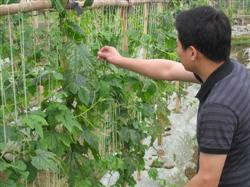
Trellising and pruning. When the seedlings grow to about 20 cm, they need to be trellised and the vines guided. There are two trellising methods: the flat shed trellis and the A-frame trellis. The flat shed trellis has good ventilation and airflow, sets many fruits and gives high yields. Flat shed trellises are further divided into connected flat shed trellises and separate flat shed trellises. A connected flat shed trellis is generally built in the melon rows by setting a wooden post every 3-4 m, then using small bamboo, small wooden sticks or nylon netting to connect the posts of the whole field into one piece, with the top of the shed about 2 m above the ground; a separate flat shed trellis generally uses every two rows of melons as one shed, with a shed height of 1.5-2 m. Trellises must be made firm to avoid being blown down by wind, which would damage the melon seedlings and affect yield. In the early stage, pay attention to manually tying the vines to help the melon vines climb onto the trellis. After bitter melon is on the trellis, no fruits should be kept below 50 cm on the main vine, and the female flowers should be removed to benefit overall development. After the main vine has set 6-7 fruits steadily, pinch off the growing tip while leaving 5-6 leaves, and at the same time remove the remaining secondary and tertiary vines. Fertilizer and water management. Bitter melon has a long growth period, and the harvest period lasts more than 3 months, so a sufficient supply of water and fertilizer must be ensured, especially once it enters the full fruiting stage; if drought occurs, water once every 7 days. Before watering, apply urea or compound fertilizer in holes at 7-10 kg per mu. If there is continuous rain, pay attention to drainage; at the same time, spray the leaves with potassium dihydrogen phosphate 2-3 times.
Pest and disease control. The main disease of bitter melon is anthracnose, which mostly occurs in the middle and late stages. For control, promptly remove residual, rotten and diseased leaves. You can also use 50% thiophanate-methyl at 800-1000 times dilution, or 70% chlorothalonil wettable powder at 600 times dilution, spraying daily in the early stage of disease onset. The main pests are aphids and cabbage caterpillars, which can be controlled by spraying the leaves with decamethrin emulsion at 1000-2000 times dilution or 40% dimethoate emulsifiable concentrate at 1500 times dilution.
Harvest seed in time. The fruits on one bitter melon plant mature one after another. During the peak fruiting period, pick the mature seed melons once a day; use scissors when picking to avoid tearing the vines. At the same time, remove off-type plants and off-type melons, and select and keep seed from those with consistent color and melon shape. Pick the same day, and extract, wash and dry the seed the same day to ensure the seed germination rate.
Click to get more bitter melon growing techniques
Click to get more vegetable growing techniques