How to grow Chinese yam for high yield? Detailed explanation of the key cultivation techniques
How can Chinese yam be grown for high yield? Please introduce the cultivation methods. To achieve high yield when growing Chinese yam, you can refer to the following cultivation methods: 1. Choose suitable varieties. Select excellent varieties with strong disease resistance such as Bangyao and Xiaobaizui. 2. Choose the plot. Select sandy loam soil with high terrain, good drainage and deep soil layers. Loosen the soil...
How can Chinese yam be grown for high yield? Please introduce the cultivation methods.
To achieve high yield when growing Chinese yam, you can refer to the following cultivation methods:
I. Choose suitable varieties. Select excellent varieties with strong disease resistance such as Bangyao and Xiaobaizui.
II. Choose the plot. Select sandy loam soil with high terrain, good drainage and deep soil layers. Loosen the soil and apply fertilizer, and dig deep trenches running north-south in the field, with a trench width of 30 cm and a depth of 120 cm. Generally, trenches are dug every other row to make operation easier. When digging, keep the upper and lower soil layers separate and pile them on both sides of the trench. After turning and airing for a few days, break up the clods, rake the trench bottom level and tread it firm, then fill in the lower layer of soil and then the upper layer of soil separately. When filling with the upper layer of soil, apply 5000 kg of farmyard manure and 50 kg of NPK compound fertilizer per mu every other layer, and tread firm once each time 20 cm of soil is filled.
III. Make beds and transplant. When the air temperature remains at 12°C and the soil temperature is stable above 10°C, transplanting can begin. In the central region of our province, the sowing period is about mid-April each year. Select the harder upper end of disease-free tuberous roots, the yam tail, as seed pieces. The seed pieces are 20 cm long. Cover them with a layer of wet sand 7-10 days before sowing, then cover with plastic film for sprouting. Open trenches at a spacing of 80 cm, with a wide-row spacing of 80 cm and a narrow-row spacing of 30 cm. The planting depth is 3-4.5 cm, and the plant spacing is generally 15-20 cm. Lay the Chinese yam tails flat in the trench in the same direction and cover with soil level with the bed surface.
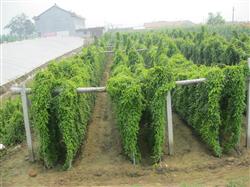
IV. Field management. For those with many sprouts, keep 1-2 strong sprouts and remove all the rest as early as possible. If there are too many side branches, remove the basal side vines and keep the upper side vines. After July, bulbils form in large numbers and affect the growth of underground tubers, so part of the bulbils should be removed. After the Chinese yam emerges, stakes should be set up to guide the vines. The trellis height is generally 1-1.5 m. Generally, 2 m long bamboo poles are used to insert herringbone trellises in the two rows of the same bed. The trellis must be firm to prevent it from being blown over by wind later. In the early growth stage, cultivate and weed frequently, generally once every half month, until the vines reach halfway up the trellis. Generally, topdress once each when the vines reach halfway up the trellis and when they cover the whole trellis, with 15-20 kg of urea, and appropriately apply some potassium fertilizer or foliar fertilizer to improve stress resistance and increase yield. Chinese yam is a drought-tolerant crop. To increase yield, under conditions of long drought without rain, lightly water 1-2 times. If there is rainy weather, promptly drain standing water in the beds to prevent waterlogging damage.
Pest and disease control. Anthracnose is a commonly occurring disease in Chinese yam production. Once leaf spots are found, in the early stage, spray the leaves with 50% mancozeb wettable powder at 500 times dilution or 50% carbendazim at 800 times dilution, generally once every 7-10 days, and 2-3 times is enough. Nematodes are a major pest of Chinese yam. The control method is generally to evenly spread 3 kg of 5% mecroprop granular formulation per mu in the planting trenches.
V. Harvest at the right time. Chinese yam is generally harvested when the stems and leaves have all withered. Harvesting too early results in low yield and easy breakage, affecting quality. The harvest time is about late October to before the Start of Winter, which is preferable. Generally, harvesting starts from one end of the bed. First dig a pit 60 cm square, sit on the edge of the pit, then use a yam shovel to follow the lateral roots on both sides of the yam at 10 cm below the ground surface and shovel out the soil beside the roots, continuing until the tip of the tuber is seen at the bottom of the Chinese yam trench. Finally, when the tip is felt to be loose after lightly testing with the shovel, hold the upper end of the Chinese yam seed piece with one hand and use the other hand to shovel upward along the tuber to cut the lateral roots behind it until the root system of the Chinese yam seed piece close to the ground layer is cut, so that a complete Chinese yam can be taken out. After drying slightly, store it in the warehouse. When loading and transporting, handle it gently and do not bruise or break it, otherwise the commercial value will be affected.
Click to get more Chinese yam cultivation techniques
Click to get more vegetable cultivation techniques