What are the key technical points for managing yam (Chinese yam) seedlings?
How do you manage yam seedlings well? Please explain the management methods. For growing yam, the following methods can be used for management during the seedling stage: 1. Trellis insertion and trellis material disinfection. It takes 25--35 days from sowing to emergence for yam, and during this period the main task is to set up the trellis well. For trellis insertion, use three bamboo poles at the edge angled inward at once, with the fourth in the opposite direction, and afterward insert the trellis in a crossing pattern of one inward and one outward, then tie it securely...
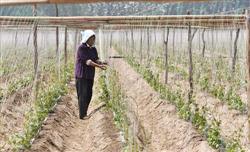
How do you manage yam seedlings well? Please explain the management methods.
For growing yam, the following methods can be used for management during the seedling stage:
1. Trellis insertion and trellis material disinfection It takes 25--35 days from sowing to emergence for yam, and during this period the main task is to set up the trellis well. For trellis insertion, use three bamboo poles at the edge angled inward at once, with the fourth in the opposite direction, and afterward insert the trellis in a crossing pattern of one inward and one outward, then tie it securely. If the bamboo poles used as trellis material were not bought in the current year, they also need to be disinfected. First, thoroughly remove the yam stems and vines remaining on the bamboo poles, then spray the bamboo poles with 50% carbendazim or 1.5% thiamisone at 300--500 times dilution, so as to kill remaining pathogens and prevent leaf diseases.
2. Control damage from mirid bugs When there are 10-20 mirid bugs per 100 plants and 3% of plants are damaged, use 1000 times dilution of mirid bug clear or 10-15 grams of imidacloprid per mu mixed with 30-40 kg of water for spraying control, or spray with 1000 times dilution of high-osmotic abamectin. In addition, pay attention to the spraying time. Because mirid bugs hide by day and come out at night, spray before 9 a.m. or after 5 p.m. to achieve better control results.
3. Timely watering and fertilizing Yam is drought-tolerant, likes moisture, and fears waterlogging. The first watering should be done in mid-June according to soil moisture, weather, and seedling conditions, to ensure the water needed for normal yam growth. Before sowing, after emergence, shallow earthing up should be carried out to prevent early root senescence. In combination with the first watering, to control nematodes use 3--5 kg of Shennongdan per mu, broadcasting it when the water is almost but not fully infiltrated; in mid-June, in combination with the second watering, carry out the first topdressing, applying 50 kg of special fertilizer for yam per mu, or 50 kg of Sakefu. Note that watering time should be after 5 p.m. until before 10 a.m. the next day. Never water at noon, as it causes root shock.
4. Chemical control must be appropriate After the yam stems and vines climb to the chrysanthemum top, chemical control should be carried out according to their growth. For vigorous growth, use 20 grams of paclobutrazol per mu mixed with 15--30 kg of water and spray the young stems and tender tips, then spray once every 10-15 days. During the peak stem and vine growth period, that is, from July 20 to August 30, according to variety, soil fertility, and growth vigor, use 40-80 grams of paclobutrazol per mu mixed with 30 kg of water to spray the tender tips. Generally, chemical control should stop after September 10. Note that when carrying out chemical control, paclobutrazol should be prepared as a separate solution to avoid affecting efficacy; the application time is preferably after 10 a.m. and before 5 p.m.; if rain occurs within 4 hours after spraying, spray again.
Click to get more yam cultivation techniques
Click to get more vegetable cultivation techniques