How to fertilize sunflowers properly? A detailed guide to scientific fertilization methods
How to fertilize sunflowers properly? Please give guidance. When growing sunflowers, you can refer to the following methods for fertilization: 1. Nutrient requirements of sunflowers. Sunflowers are a crop with relatively high nutrient demands. The period from flower head formation to flowering is the peak period of nutrient demand for sunflowers. From emergence to flower head formation, phosphorus demand is relatively high; from flower head formation to...
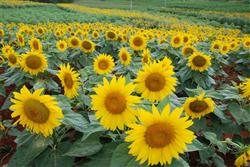
How to fertilize sunflowers properly? Please give guidance.
When growing sunflowers, you can refer to the following methods for fertilization:
1 Nutrient requirements of sunflowers
Sunflowers are a crop with relatively high nutrient demands. The period from flower head formation to flowering is the peak period of nutrient demand for sunflowers. From emergence to flower head formation, phosphorus demand is relatively high; from flower head formation to the end of flowering, nitrogen demand is relatively high; from flower head formation to the dough stage, potassium uptake is the highest. Therefore, when fertilizing sunflowers, phosphorus should be the main nutrient in the early stage, and nitrogen and potassium should be the main nutrients in the middle and late stages. For every 100 kg of sunflower seeds produced, 4.59-6 kg of nitrogen (n), 2.6-3.04 kg of phosphorus (p2o5), and 18.6-30 kg of potassium (k2o) need to be absorbed from the soil. Phosphorus and potassium fertilizers are mostly applied as base fertilizer or seed fertilizer, while nitrogen fertilizer is applied as topdressing, or 1/3 as base fertilizer and 2/3 as topdressing.
2 Fertilization techniques for sunflowers
The fertilization principle is to apply sufficient base fertilizer, apply seed fertilizer heavily, and topdress at the appropriate time. Base fertilizer is mainly farmyard manure. Pig manure and decomposed barnyard manure are preferable. Generally, 1500-2500 kg per mu for ordinary fields, and 3000-4000 kg per mu for high-yield fields. If phosphate fertilizer is used as base fertilizer, generally 30 kg of superphosphate is applied per mu for ordinary fields, and about 50 kg for high-yield fields. For potassium fertilizer, 50-75 kg of plant ash can be applied per mu. However, do not use plant ash in saline-alkali land. Seed fertilizer should use quick-acting nitrogen, phosphorus, and potassium chemical fertilizers and well-decomposed, finely crushed human, poultry, and livestock manure and urine. The amount should be small and refined. Generally, 15-30 kg of superphosphate, 10-15 kg of potassium chloride or potassium sulfate, or 35 kg of plant ash can be applied per mu. On barren hillside land or sandy gravel soil, an additional 4-7 kg of ammonium nitrate or about 10 kg of ammonium sulfate is needed. It can be applied in holes or in furrows in the sowing ditch.
Topdressing is divided into seedling-stage topdressing and flowering-stage topdressing. Seedling-stage topdressing: for spring-sown sunflowers with one crop per year, topdressing is generally not applied when the base fertilizer or seed fertilizer is relatively sufficient. However, sunflowers sown in summer and autumn need seedling fertilizer topdressing.
Flowering-stage topdressing: The key period for topdressing sunflowers is before budding. Nitrogen and potassium fertilizers are generally topdressed at the 7-8 leaf stage, and topdressing should be appropriately earlier if no seed fertilizer was applied. For topdressing, generally 10-15 kg of ammonium nitrate, 20-25 kg of ammonium bicarbonate, 7.5-10 kg of urea, 20 kg of superphosphate, and 15 kg of potassium chloride are applied per mu. Apply in furrows or holes. Boron fertilizer has a good yield-increasing effect on sunflowers. When the available boron content in the soil is less than 0.4 mg/kg, boron fertilizer should be added. You can mix 150 grams of borax per mu for seed dressing, or spray with a 0.1%-0.2% borax aqueous solution before flowering. In Heilongjiang, sunflower fertilization is 13.5 kg of nitrogen (n) and 4.5 kg of phosphorus (p2p5) per mu, with nitrogen (n):phosphorus (p2o5) at 1:0.33. That is, 29.35 kg of urea and 9.8 kg of triple superphosphate per mu. In Jilin, the suitable amount is 4 kg of nitrogen (n), 4 kg of phosphorus (p2o5), and 1 kg of borax per mu.
Click to get more sunflower growing techniques
Click to get more grain and oil crop growing techniques