How can you grow peppers in summer to achieve high yields?
How can you grow peppers in summer to achieve high yields? Please explain the cultivation methods. For growing peppers in summer, you can refer to the following methods: 1. Variety selection. Over-summer cultivation of peppers mainly supplies the summer and autumn seasons. Because temperatures are high and humidity is great, diseases are easily triggered, causing reduced yields or even total crop failure. Therefore, choose medium-late and late maturing pepper varieties that are heat tolerant, disease resistant, large fruited, good in commercial traits, and high yielding, such as Zhengjiao No. 12. Some medium maturing varieties with good resistance, such as Zhengjiao Xianfeng, can also be selected. If shipping externally, the selected varieties should also have thick flesh, resistance to pressure, and tolerance for storage and transport, such as Zhengjiao No. 16, Xiangjiao No. 37, etc.
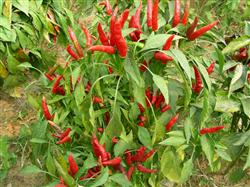
How can you grow peppers in summer to achieve high yields? Please explain the cultivation methods.
For growing peppers in summer, you can refer to the following methods:
1 Variety selection
For over-summer cultivation, peppers mainly supply the summer and autumn seasons. Because temperatures are high and humidity is great, diseases are easily triggered, causing reduced yields or even total crop failure. Therefore, choose medium-late and late maturing pepper varieties that are heat tolerant, disease resistant, large fruited, good in commercial traits, and high yielding, such as Zhengjiao No. 12. Some medium maturing varieties with good resistance, such as Zhengjiao Xianfeng, can also be selected. If shipping externally, the selected varieties should also have thick flesh, resistance to pressure, and tolerance for storage and transport, such as Zhengjiao No. 16, Xiangjiao No. 37, etc.
2 Sowing and raising seedlings
Peppers generally need 60-80 d from sowing and seedling raising to budding and flowering, but in summer when temperatures are higher, the time required will be correspondingly shortened. When planted in succession with garlic, rapeseed, etc., or intercropped with watermelon (sweet melon) or wheat, in the Central Plains region sowing and seedling raising are generally done in mid to late March; when transplanted after wheat stubble, sowing and seedling raising are generally done in early April. The seedbed is set up in the open field, but because temperatures are low in the early seedling stage, a small arched tunnel needs to be covered, then removed after the late frost. To reduce root damage from pricking out seedlings, reduce the non-growing period, and prevent disease, the method of sowing once to grow seedlings is generally used, so sparse sowing is needed. After emergence, thin the seedlings 2-3 times, and final thinning when there are 1-2 true leaves, with a seedling spacing of about 12 cm. The number of seedlings left per hole varies with the cultivation method. When planted in succession with garlic, rapeseed, wheat, etc., leave 1 robust seedling per hole; for intercropping with melons or wheat, leave 2. If the seedlings show drought and water shortage, water lightly in time; when watering, a small amount of fertilizer can be applied to promote seedling growth. Water once 1-2 d before transplanting to facilitate lifting seedlings with soil.
3 Transplanting
When planted in succession with garlic, rapeseed, wheat, etc., harvest, plowing, and early transplanting should all be done quickly. After the previous crop is harvested, immediately clear stubble, apply fertilizer, plow, make beds, and transplant. Because peppers are afraid of waterlogging, small high beds should be used for cultivation. But do not cover with plastic film. Plant the seedlings on both sides of the small high beds near the ground-level shoulder, to facilitate watering and drainage. You can transplant at equal row spacing, but wide and narrow row spacing is best for management. Wide rows: peppers 70-80 cm, sweet peppers 60 cm; narrow rows: peppers 50 cm, sweet peppers 40 cm. Summer temperatures are high and viral diseases easily occur, so over-summer peppers should be appropriately densely planted. Especially sweet peppers: with high density, dense branches and leaves, and early row closure, sunscald can be better prevented, and the ground temperature can be reduced by 1-2 degC, keeping the ground moist and forming a good field microclimate, which is beneficial to normal plant growth and development. Hole spacing: peppers 33-40 cm, one plant per hole; sweet peppers 25-33 cm, two plants per hole. Before transplanting, apply 75 t/ha of decomposed high-quality farmyard manure, 750 kg/ha of superphosphate, and 375 kg/ha of potassium sulfate as base fertilizer. When intercropping with watermelon (sweet melon), early maturing varieties should be selected for the watermelon (sweet melon), and plastic film mulching cultivation should be used. Pepper seedlings can be interplanted about 30 d after sowing the watermelon (sweet melon). Interplant 2 rows of peppers per ridge of watermelon (sweet melon), that is, between 2 watermelon (sweet melon) plants, puncture the film on both sides of the ridge and transplant 1 hole of peppers in each opening. When intercropping with wheat, the wheat is generally in the field with 2.0-2.2 m as 1 strip, sown with 2 seed drills, leaving an empty bed 0.8-1.0 m wide for transplanting peppers. Transplant in early to mid May, planting 2 rows of peppers flat in the reserved empty bed, with hole spacing of 50 cm, 2 plants per hole, narrow row spacing of 60 cm, and wide row spacing of 1.5-1.6 m. When transplanting, dig holes according to the hole spacing and plant the seedlings. Choose a cloudy day or after 3 p.m. on a sunny day, to minimize seedling wilting. Water the seedbed 1 d before lifting seedlings; when lifting seedlings, carry as much native soil around the roots as possible, prevent the soil ball from breaking during transport, and minimize root damage. Immediately cover with soil and water after planting. During the seedling recovery period, water 2-3 times consecutively to lower ground temperature and speed up recovery.
4 Field management
After transplanting, if the weather is dry, replenish water in time to help the seedlings recover. After seedling recovery, apply 1 seedling-promoting fertilizer, applying 105-150 kg/ha of diammonium phosphate to promote early plant development, but the topdressing amount must not be large, as too much easily causes excessive vegetative growth. After seedling recovery, carry out 1 intertillage in time to break soil crusting, increase root oxygen uptake, promote strong seedlings, and prevent excessive vegetative growth. Summer temperatures are relatively high. When it does not rain, sandy loam soil should be watered about once every 7 d. It is best to water with cool well water in the evening. Watering with cool well water can lower the field temperature from high to suitable, and it will still have a cooling effect for several days afterward. Do not water during the day when temperatures are high; when watering at high temperatures, the field temperature quickly rises again, and peppers are prone to viral diseases and other problems affecting growth. During the full fruiting period, topdress 3-4 times in combination with watering, each time applying 150-300 kg/ha of urea or diammonium phosphate. In the early and middle stages of growth, timely intertillage, weed control, and hilling should be carried out. After fruit set, intertillage should not be done to avoid disease. After the Autumn Equinox, temperatures gradually decrease and fruit growth slows. Pay attention to applying quick-acting fertilizer, combining watering with 225 kg/ha of diammonium phosphate or 150 kg/ha of urea, and pay attention to foliar spraying of potassium dihydrogen phosphate and trace element fertilizers to ensure full development and growth of later fruits. In midsummer, temperatures are relatively high, air humidity is low, and soil evaporation is large. To prevent excessive evaporation of soil moisture, it is best before row closure and before high temperature and drought arrive to use rice straw or crop stalks, etc., to cover the pepper bed surface with 1 layer. First, it lowers soil temperature, reduces ground moisture evaporation, and plays a role in preserving water and fertilizer; second, it prevents weeds from growing densely; third, it reduces the impact of heavy rainwater on the bed surface soil and prevents soil surface crusting. The covering thickness should preferably be 3-4 cm. Too thin will not achieve the proper covering effect, while too thick is not good for pepper ventilation and easily causes flower drop and fruit rot.
5 Harvesting
The first fruit should be harvested in time, so that it does not absorb nutrients and affect the plant's fruit setting and reduce yield. Sweet peppers are generally marketed as green fruits. Peppers should be harvested in time when the fruit is dark green, firm, and glossy. When red fruits fetch a high price, some red fruits can also be harvested. For winter storage and fresh-keeping, green fruits must be picked to extend the fresh-keeping period, and they should be harvested all at once before Frost's Descent.
Click to get more pepper cultivation techniques
Click to get more vegetable cultivation techniques