Detailed Explanation of Harvesting and Processing Techniques for Honeysuckle (Jinyinhua) Medicinal Material
1. Flower-picking time: The picking time is from 9 to 12 o'clock in the previous year; it is not suitable to pick when there is dew or on rainy days, but it can also be picked if there is drying equipment. Flowers picked in the morning are blue-white, heavy, easy to dry, have a strong fragrance, a high rate of commercial product output, and good quality. Flowers picked after noon and on cloudy days are poorer in quality and have a low processing rate. From the flower's development process...
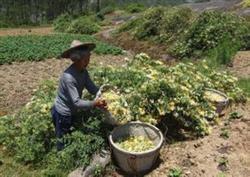
1. Flower-picking time: The picking time is from 9 to 12 o'clock in the previous year; it is not suitable to pick when there is dew or on rainy days, but it can also be picked if there is drying equipment. Flowers picked in the morning are blue-white, heavy, easy to dry, have a strong fragrance, a high rate of commercial product output, and good quality. Flowers picked after noon and on cloudy days are poorer in quality and have a low processing rate. From the perspective of the flower's development process, it is customarily divided into several stages: green bud, green-white, large white needle, silver flower, and golden flower wilted flower. Those in which the upper part of the bud is swollen, grows into a rod shape, and is blue-white are considered good, customarily called large white needle. At this time the flower is about to open, making it the best picking time, and it can be processed into a high-quality commercial product.
2. Picking method: When picking, use bamboo baskets or rattan cages; do not use cloth bags, plastic (11180,-55.00,-0.49%) bags, or paper boxes, to prevent heat and moisture, fermentation of enzymes and proteins in the body, discoloration, and mold. The buds and flower tissues are very tender, so they must be picked and placed gently; do not grasp, pinch, or press hard with the hands, so as to avoid affecting quality.
3. Air-drying and drying: Dry immediately after picking, and sun-dry on clear days. Spread thinly for drying using bamboo mats or straw mats, with a thickness of 1 cm, and do not turn them over frequently. When 70% dry, place in a bright place to dissipate heat and sweat, then sun-dry again until dry. The standard is reached when the flowers do not become brittle and broken. On cloudy and rainy days, they must be dried at low temperature; first dry at 35°C-40°C for 2-3 hours, then raise the temperature to 50°C and dry until 90% dry, without damage. Large planting areas and production regions should build drying rooms to strictly prevent mold and improve commercial quality. Generally, 6-7 kg of fresh flowers dries into 1 kg of commercial product.
4. Processing and grading: Processing must start with picking and drying, and it is best to dry separately according to quality, removing impurities at any time, to produce more first-grade commercial product. The national standard for honeysuckle commercial product is divided into four grades.
First grade: Dry goods, buds are rod-shaped, thick at the top and thin at the bottom, slightly curved, surface blue-white, corolla thick and slightly hard, with a firm feel when held; clear fragrance, sweet and slightly bitter taste. Open flowers, split buds, and yellow strips do not exceed 5%. No black strips, black heads, branches and leaves, impurities, insect damage, or mold;
Second grade: Basically the same as first grade, except open flowers do not exceed 5%. Split buds and yellow strips do not exceed 10%;
Third grade: Dry goods, buds are rod-shaped, thick at the top and thin at the bottom, slightly curved, surface blue-white or yellow-white, corolla thick and hard in texture, with a firm feel when held. Clear fragrance, sweet and slightly bitter taste. Open flowers and black heads do not exceed 30%. No branches and leaves, impurities, insect damage, or mold;
Fourth grade: Dry goods. Buds or open flowers may both be present, with no distinction in color. Branches and leaves do not exceed 3%, and there are no impurities, insect damage, or mold.
Recently, goods have been in short supply and sell well, so they are generally mostly processed into mixed grades. However, planting should emphasize quality, take the Good Agricultural Practice for Chinese Materia Medica (GAP) as the principle, build industrialized bases, create genuine regional brand-name products, and improve reputation and benefits.